
Boring at the Edges
Been boring at the base layer is a precondition, not a personality flaw, and what make risk possible!
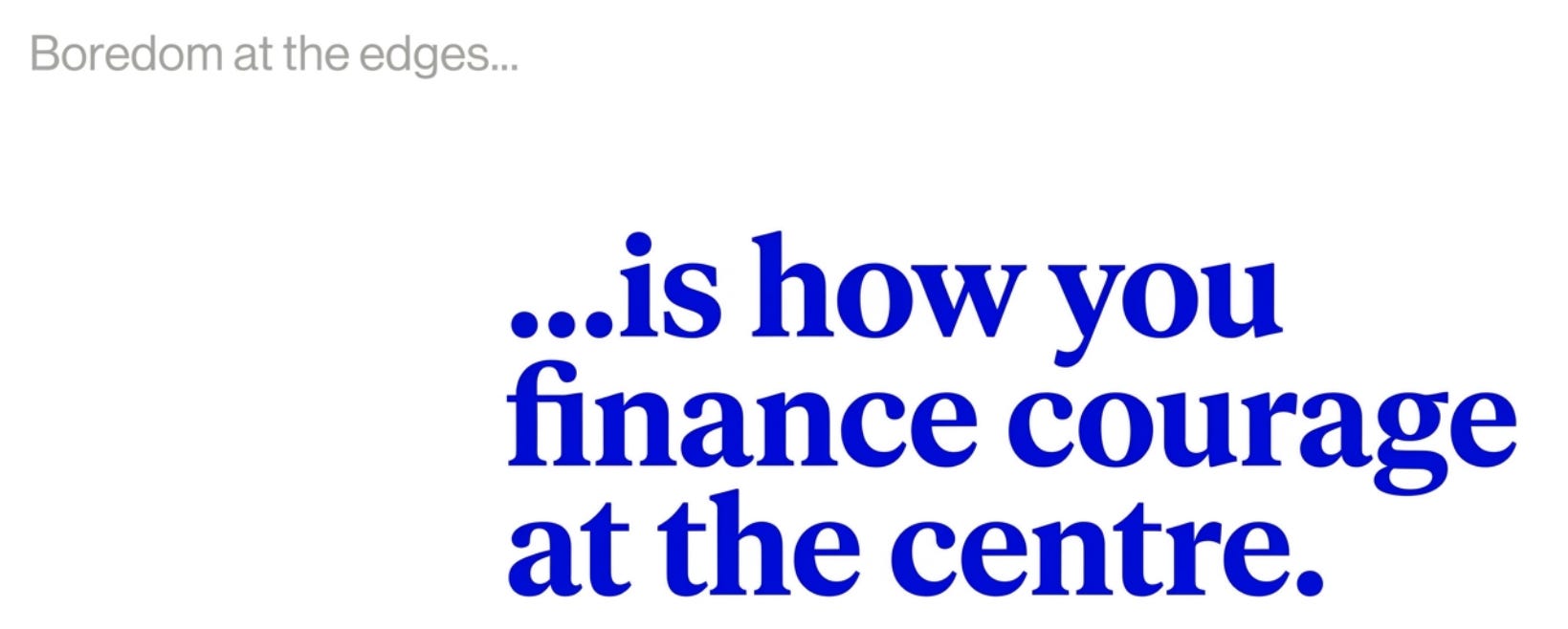
Boredom at the edges is how you finance courage at the centre.
I have ordered the same coffee, same breakfast, same food (mostly veg thali), and almost prefer to take the same seat when it is free (when we are out for our foods).
And, for this, my wife’s critique is predictable. “You are no longer exploring. You have stopped being curious. You are optimising the life out of life”.
And, for this, I never had a good defence because I did not think the americano required one. But, then recently I thought more on this, and here is a post: The boring life can be infrastructure.
What looks like monotony from the outside is a decision made much earlier: some parts of life deserve continuing attention.
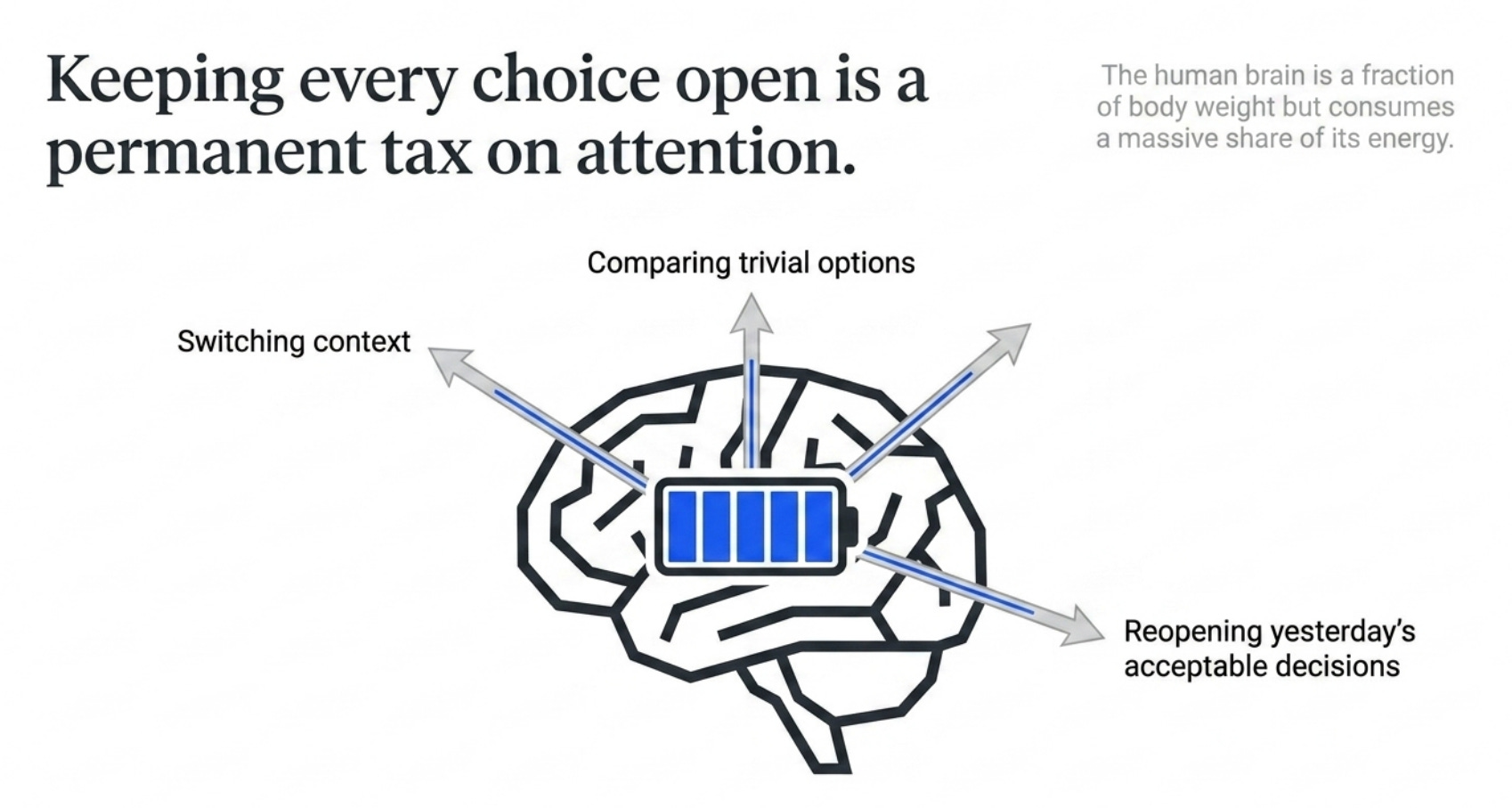
Keeping every choice open is not curiosity. It is a permanent tax on attention.
Close the ticket
The human brain accounts for only a small share of body weight but consumes a large share of its energy. Thought is expensive. So is switching context, comparing options and reopening decisions that produced an acceptable answer yesterday.
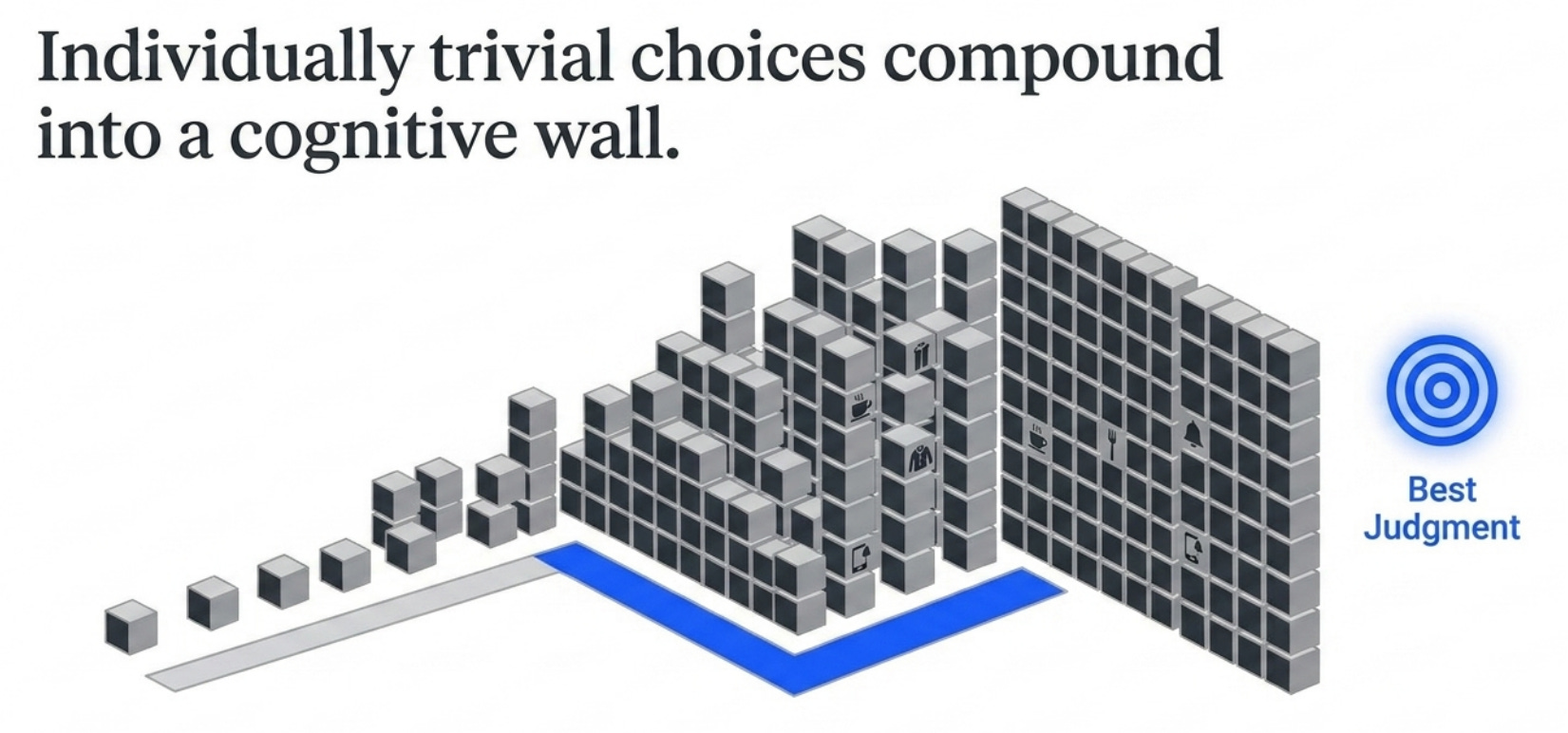
The cost of choosing breakfast is tiny. That is precisely why it survives unnoticed. A new route, a different order, another shirt, one more app notification. Each is individually trivial. Together, they create an environment in which the mind is always making small adjustments before it reaches the work that needs its best judgment.
Routine closes these minor loops.
The same breakfast means the investigation is over. The same coffee means the first decision of the morning has already been made. The answer may not be globally perfect. It only needs to be good enough that searching for a marginally better one no longer deserves the cost.
This is what companies do with standard operating procedures-SOPs. A bank does not ask every branch employee to reinvent the process for opening an account. A factory does not debate the position of each tool at the start of every shift. Stable processes protect scarce attention for exceptions, failures and judgment calls.
Yet in personal life, we often treat the absence of repeated choice as a failure of imagination.
Jobs uniform
Steve Jobs’s public uniform became almost inseparable from him: black mock turtleneck, jeans, trainers.
The clothes became a story about eccentricity. The operating logic was simpler. Wardrobe was a category in which additional thought produced almost no meaningful return. Remove the category, and attention remains available for decisions where small differences could change the product.
Jobs was famously particular about products because product decisions compounded. The curve of a corner, the feel of an interaction, the number of steps between intention and result: these details affected millions of users, repeatedly.
The choice between two shirts did not.
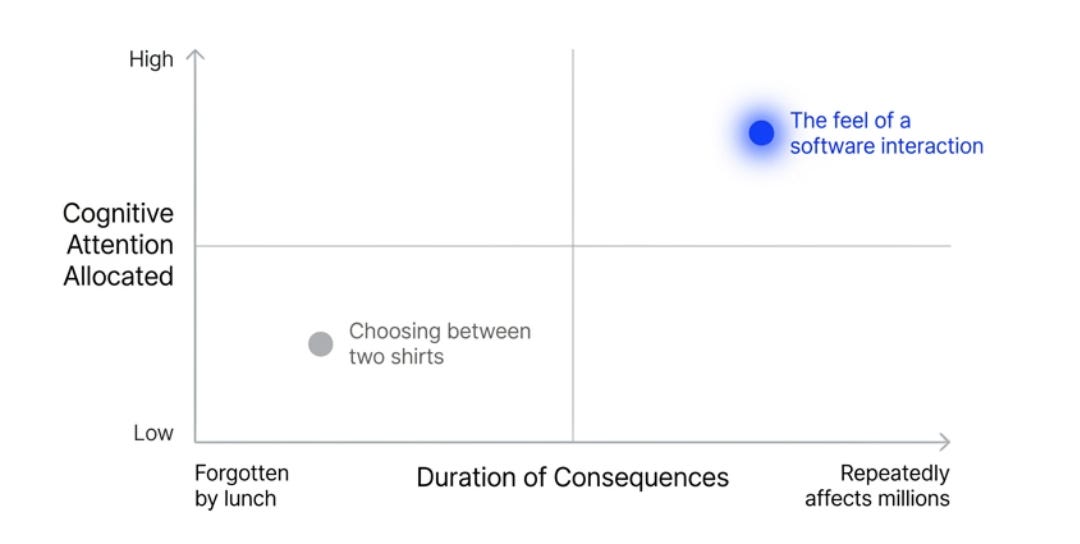
That is capital allocation applied to cognition. High-quality attention is finite. A sensible system does not distribute it democratically. It directs more of it towards decisions with long consequences and less towards decisions that will be forgotten by lunch.
Certainty at the base layer expands the room for risk above it.
What boredom buys
But then, eating the same lunch does not make someone Steve Jobs. Removing low-value decisions creates capacity; it does not decide where that capacity goes.
The useful question is therefore not whether a life looks boring. It is whether the reclaimed attention is being deployed somewhere that requires courage.
A founder may keep the same morning because the company changes every afternoon. A writer may protect the same desk, hour and walk because the page itself must remain uncertain. A parent may make the household predictable because children produce enough surprise without help.
The routine absorbs variance at the edge so that the person can carry more variance at the centre.
That is the part the critique misses. We have started treating novelty as evidence of curiosity. But curiosity is not measured by the number of new cafés visited. It is measured by the depth of the question you were able to stay with after the coffee was done.
The point is not to make life smaller. It is to stop spending your best attention proving that every corner of it is still open.
I suspect this is the shortest post I have written in a while.
Perhaps that is what happens when you start building again. You close a few more tickets at the edges because the work at the centre has become larger.
Last week, I shared Datalab, a public window into some of the data we have been assembling. A few more parts of the work under AffluenceQ are now taking shape:
LocationQ: What can a location tell you about the people, demand and economic capacity around it?
RateQ: What can existing market signals tell you about the price, rate or offer that might make sense?
AffluenceQ: How can a business identify the right customers earlier, before spending money acquiring or pitching to everyone?
Different products, but one underlying question: what can you know before the usual customer signals arrive?
The coffee is still the same. The questions I am spending my time on are not.
Very true. We can make choices when it comes to where you want to pay attention to. But if one decides to pay it in coffee rather than on a software, it is still a good choice - life after all is not measured by the number of people impacted by what we do. If a person stays curious with food choices, and it makes them happy. It still can inspire others. A child does not calculate about the impact it creates, and nobody can inspire us more than a child does.