
Some Failures Are a Beginning
The IBM's 40-Year Pattern of Missing the Control Point.
“I think there is a world market for maybe five computers” is widely attributed to IBM founder Thomas Watson Sr. in 1943.
However, according to historians, there is no evidence he ever said this. It is widely considered a myth or misinterpretation of remarks. I will say this with more confidence since,
IBM often saw the future, entered it early, and still misjudged where its economics would settle.
Yesterday, IBM lost roughly a quarter of its market value in one trading session. About $68bn disappeared. Preliminary quarterly revenue of $17.2bn fell roughly $600m short of expectations, infrastructure revenue declined 7%, and chief executive Arvind Krishna admitted that IBM had failed to move quickly enough when customers abruptly redirected spending.
The immediate explanation was a shortage of memory chips.
Fearing further price increases, large companies pulled forward purchases of servers, storage and memory. Money that IBM expected to flow into software and mainframes went elsewhere. Software revenue still grew 5%, Red Hat continued to expand, margins remained healthy and IBM presented the disruption as temporary.
That explanation may be correct. But Tuesday’s fall was too large to be about one quarter alone. Investors were also pricing an older fear:
IBM has repeatedly arrived at an important technological transition without controlling the part of it where value eventually accumulates.
The first and most expensive instance began in 1981.
The Tramp and the box
IBM introduced its personal computer with Charlie Chaplin’s Little Tramp.
In the advertisements, a mime in a bowler hat approached the unfamiliar machine with theatrical hesitation. The message was reassuring: the computer had become small, approachable and safe enough for an ordinary office.
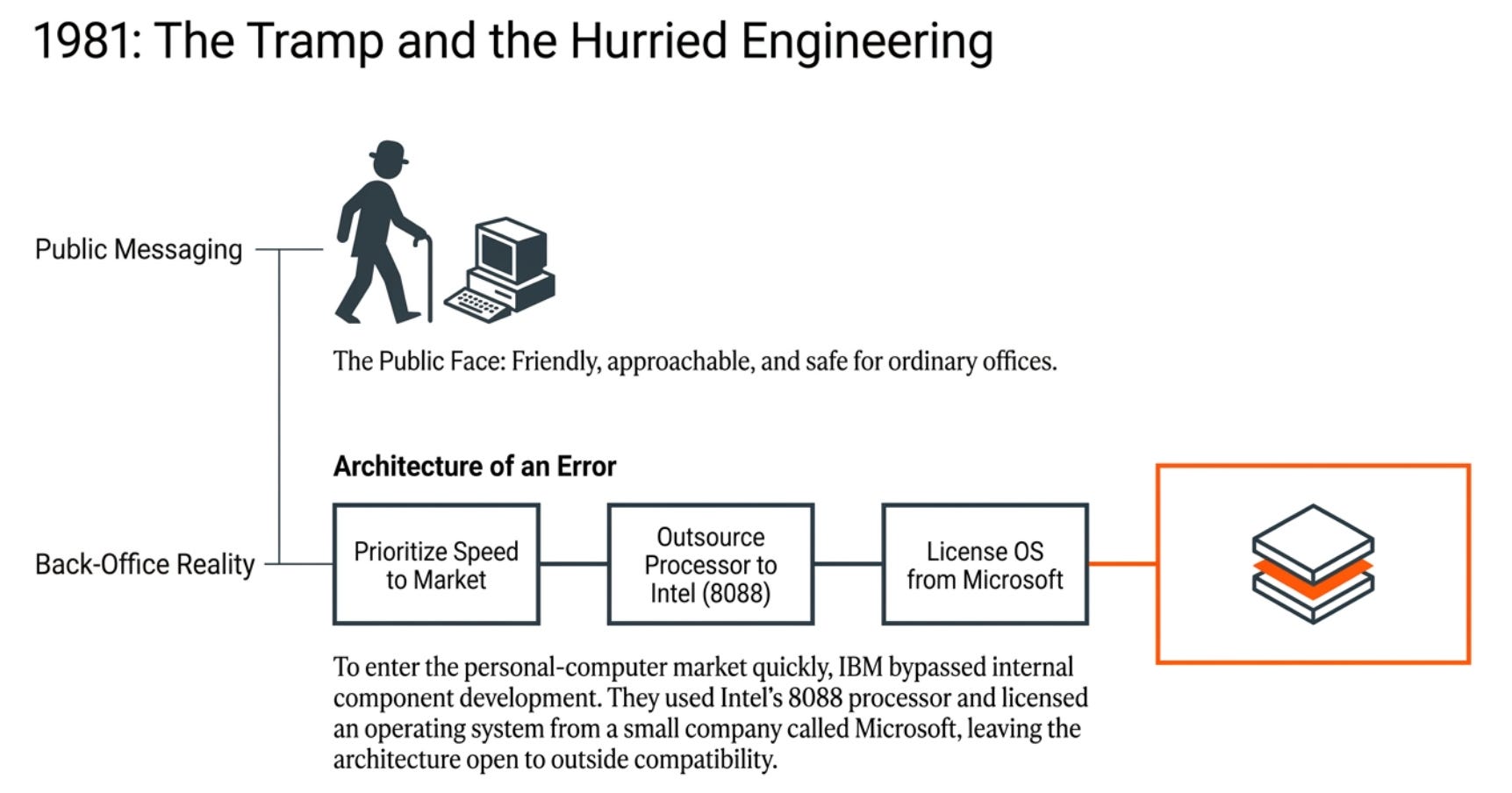
Behind that friendly campaign sat a hurried engineering decision.
IBM wanted to enter the personal-computer market quickly. Rather than develop every component internally, it used Intel’s 8088 processor and licensed an operating system from a small company called Microsoft. The PC’s architecture was largely open, allowing outside companies to make compatible components and software.
Each decision shortened the route to market for IBM. But, it also determined who would benefit once IBM’s design became an industry standard.
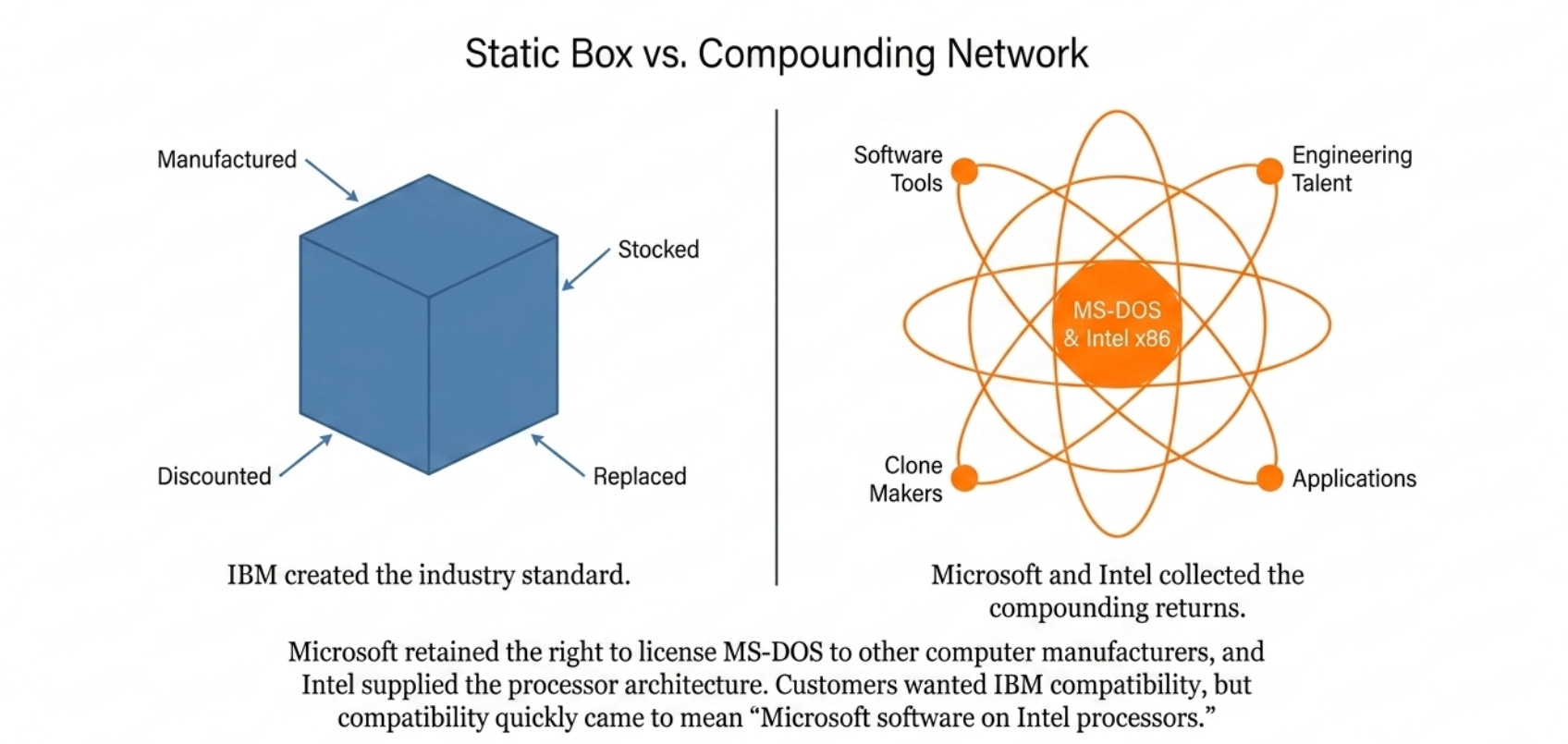
Customers wanted an IBM-compatible computer, but compatibility increasingly meant Microsoft software running on Intel processors.
IBM had created the standard. Microsoft and Intel collected the compounding returns.
The distinction mattered. A box had to be manufactured, stocked, discounted and replaced. An operating system gained value as more applications were written for it. A processor architecture attracted software tools, engineering talent and manufacturing investment. Every new PC maker intensified competition against IBM while strengthening Microsoft and Intel.
None of this was inevitable. IBM still controlled the BIOS, owned more than 20% of Intel at one point and held a licence to manufacture x86 processors itself. What it lacked was institutional conviction. IBM’s sales machinery remained oriented towards mainframes and minicomputers; employees could admire the PC without being rewarded for prioritising it. When IBM finally tried to regain control through the more proprietary, clone-resistant PS/2, the market had already organised itself around compatibility. The company had first made openness successful, then watched suppliers and clone makers capture its benefits, and finally tried to close the system after openness had become the standard. The technology moved faster than IBM’s internal hierarchy of importance.
IBM understood this model unusually well. Its System/360 mainframe had succeeded because IBM controlled the architecture around which customers, software and technical skills accumulated. Yet in the PC market it treated the operating system and processor as inputs rather than future centres of power.
In 2005, IBM sold its PC division to Lenovo for $1.75bn.
From owning the system to serving it
The PC was not the last technological transition IBM entered without securing its economics.
IBM had the enterprise relationships, data centres, engineers and corporate trust required to become a major cloud provider.
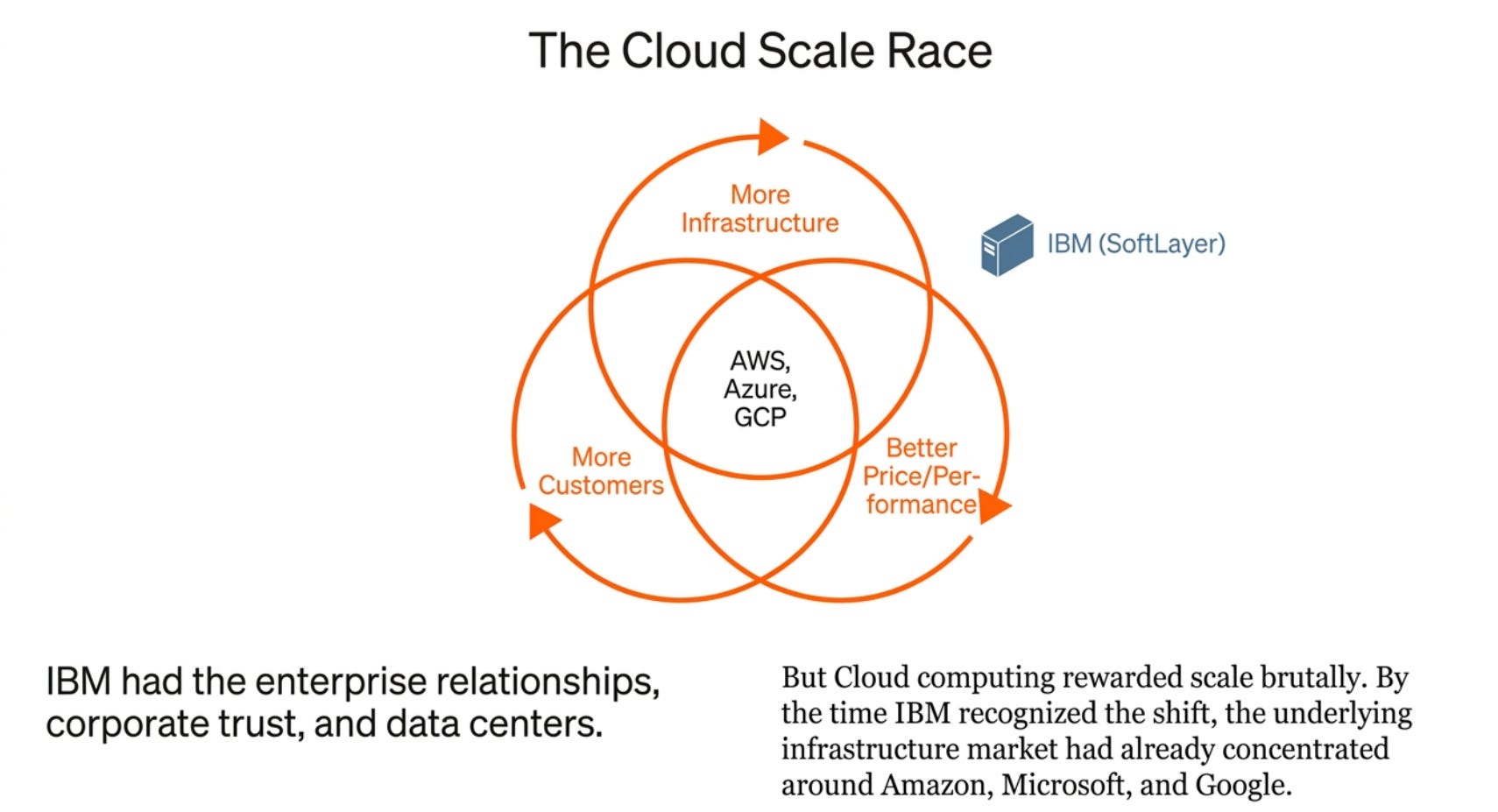
It bought SoftLayer in 2013 and built IBM Cloud. But Amazon had already converted its own computing infrastructure into a rentable platform. Microsoft then used its developer base and corporate software relationships to build Azure. Google followed with its own infrastructure and AI advantages.
By the time hybrid cloud became IBM’s preferred territory, the underlying infrastructure market had already concentrated around AWS, Azure and Google Cloud.
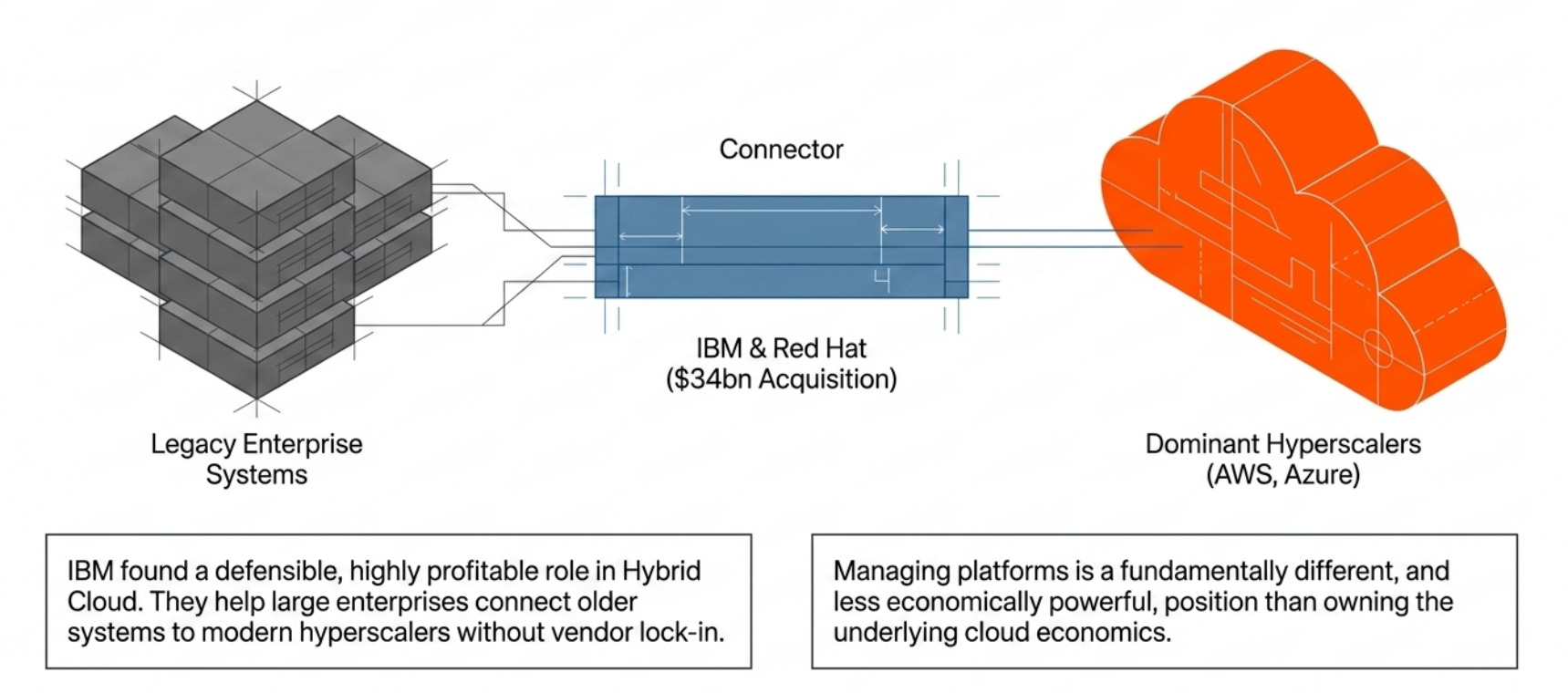
IBM then found a defensible role, especially after buying Red Hat for $34bn.
It could help large enterprises connect old systems to several clouds without becoming dependent on one provider. But this was a different position from owning the cloud itself. IBM increasingly became the company that helped customers manage platforms whose economics belonged elsewhere.
Watson followed another variation of the pattern.
After Watson defeated two champions on Jeopardy! in 2011, IBM attempted to turn the achievement into an enterprise AI business. Healthcare became its grandest test. IBM acquired medical data and analytics companies, promoted Watson as a system capable of assisting difficult clinical decisions, and attached one of the world’s most trusted technology brands to the promise.
The difficulty lay between a demonstration and a working institution. Clinical data was fragmented. Hospital workflows differed. Recommendations required evidence, accountability and integration into decisions made under legal and medical risk. Watson’s intelligence could not simply be inserted above those constraints.
In 2022, IBM sold Watson Health’s data and analytics assets to Francisco Partners.
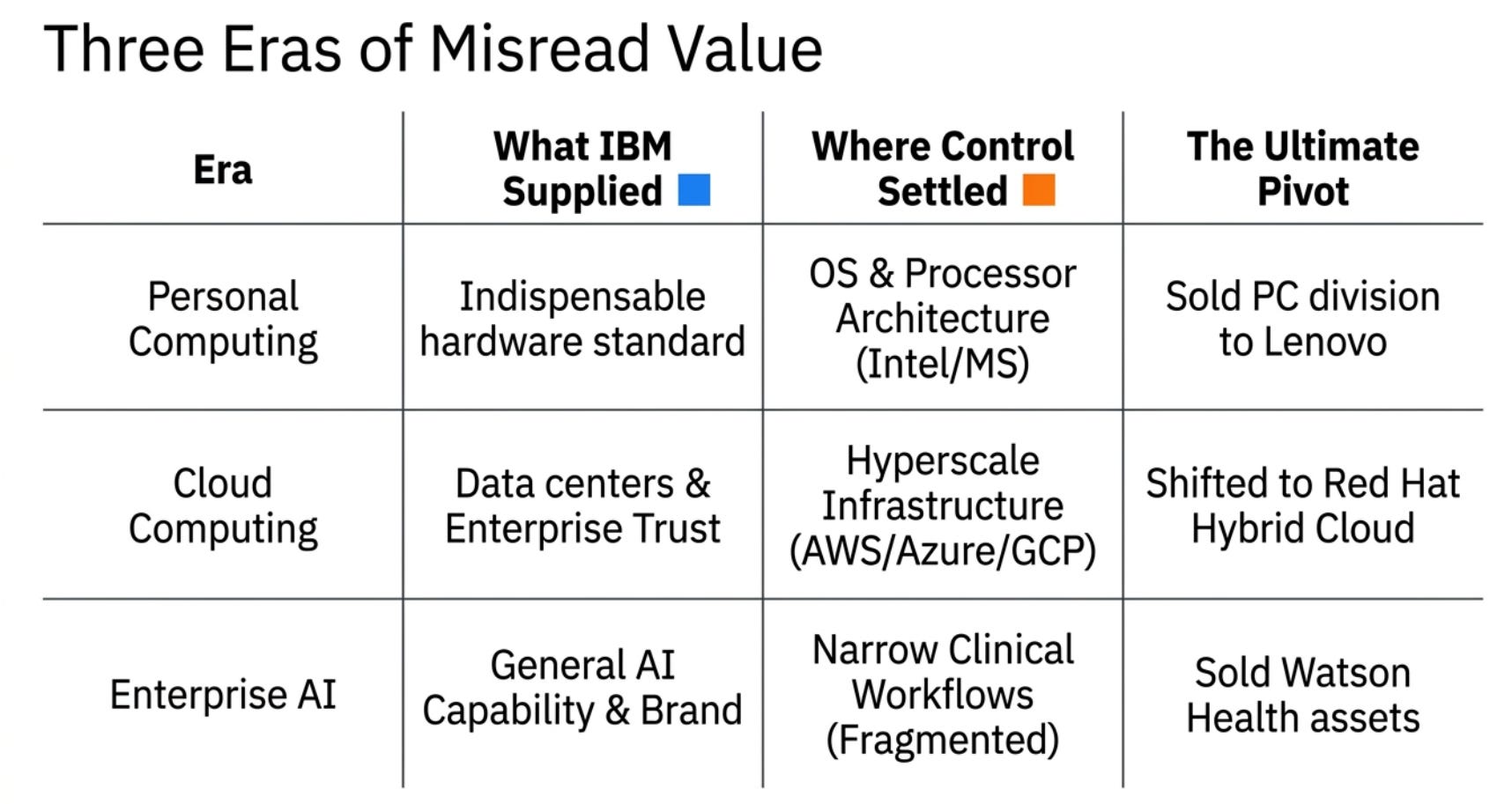
The PC, cloud and Watson were different failures. IBM gave away the PC’s control points. It lost the cloud’s scale race. In Watson, it advertised a general capability before it had solved the narrow workflows required to make that capability dependable.
The common mistake was subtler than repeatedly “giving away a layer.” IBM participated in each new market and often supplied something indispensable. But it misread where control would settle once the market matured.
What Tuesday revealed
In Freedom of Failure, I argued that failure only becomes design when an institution builds the machinery to extract signal from it. Otherwise, each mistake is explained locally, defended by the logic of its moment, and filed away.
That appears to be what happened at IBM.
The 1981 PC decisions were individually defensible. External components helped IBM ship quickly. An open architecture attracted developers. Microsoft and Intel reduced development risk. Even the later retreat from PCs could be described as a sensible exit from a low-margin business.
At every stage, the explanation worked. What remained obscured was the sequence: IBM had created a standard, surrendered its control points, failed to reclaim them through the PS/2, and eventually sold the box while Microsoft and Intel retained the economics.
Nothing forced these decisions to be read together.
There is an inverse version of this failure. As I wrote in The Prophets Who Shipped Too Soon, General Magic tried to coordinate an entire future before its supporting conditions existed: handheld devices, an operating system, software agents, hardware partners and AT&T’s PersonaLink network. The future it imagined was remarkably accurate. Just that things around that were not ready, like available batteries, networks, processors and customer behaviour.
General Magic attempted to assemble too much of an unready system. IBM repeatedly controlled too little of a system it had helped make ready.
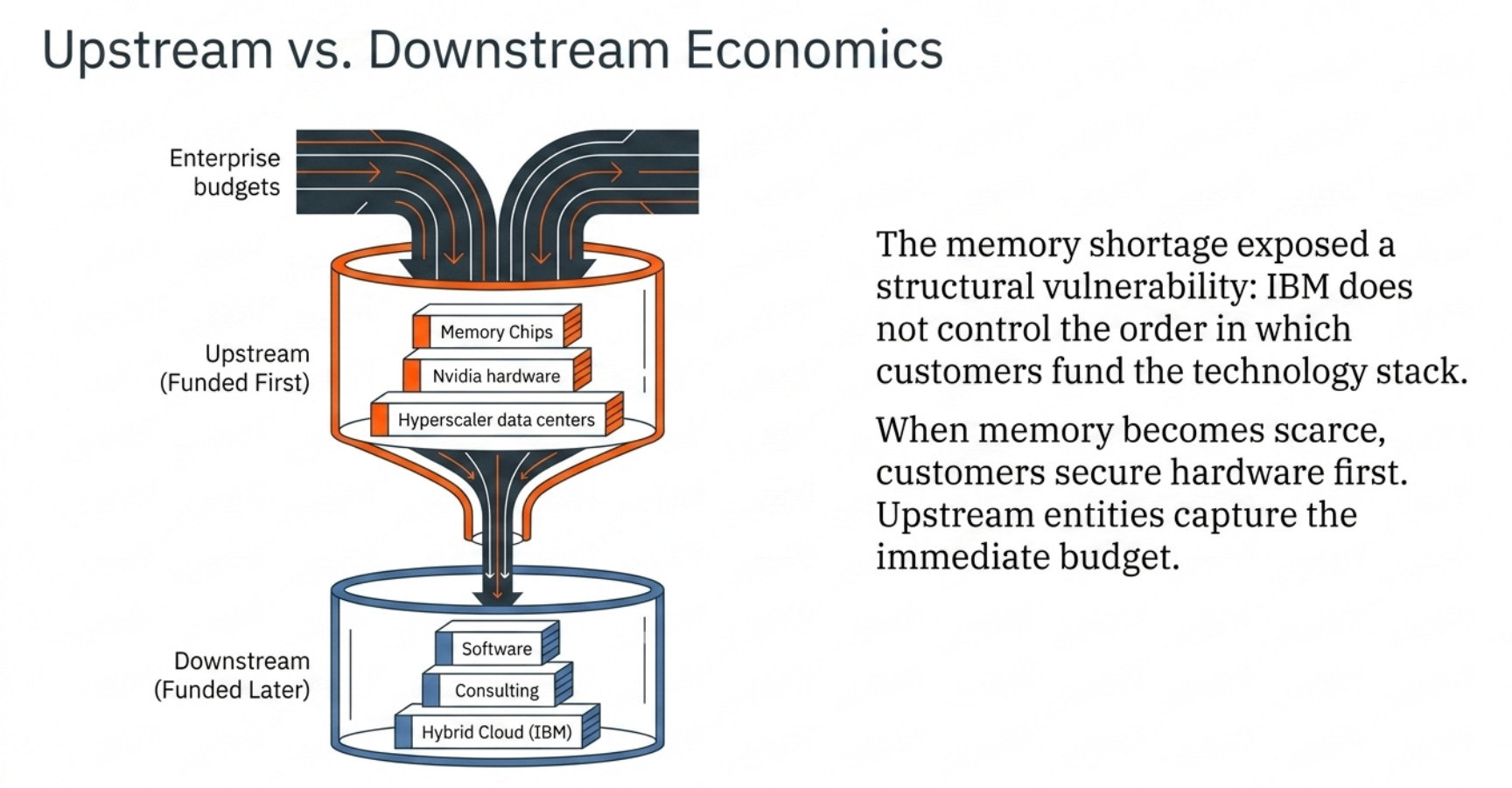
IBM sits downstream from those decisions. Its software, consulting and hybrid-cloud products become more valuable once customers are ready to connect, govern and use the infrastructure they have bought. Red Hat’s growth and IBM’s cash generation show that this can remain a substantial business. But downstream businesses absorb the consequences of investment decisions made upstream.
The market was therefore reacting to more than delayed contracts. It was asking whether IBM’s software has become a compounding control point, or remains a category of enterprise spending that customers can postpone whenever scarcity appears elsewhere.
In 1981, IBM believed the value would remain with the computer carrying its badge. Microsoft and Intel discovered that it would accumulate in the layers every compatible computer required. During the cloud transition, IBM retained the corporate relationship while Amazon, Microsoft and Google built the infrastructure underneath it.
Now AI is rearranging the stack again. IBM has enterprise access, Red Hat and tools for integration and governance. What it has not yet shown is which part of that position becomes more valuable each time another customer arrives.
It’s me, Sid. You can connect with me on LinkedIn, X, or email.
This is definitely the market researcher in me who swears by SPSS talking... Could analytics be something where IBM could control the economics?
Nice one, Sid ! Some follow ups questions/comments:
a) Examples where one transformation happened and led to a lot of success but that couldn't be repeated? Eg. Adobe's shift to the cloud was a great and an early move but the unit of work was changing underneath because of AI (Figma was rearranging it and ironically Figma itself could be at risk because of the frontier labs making it a feature).
b) Frequently, business choices are made copying an old pattern the CXOs have seen successful at earlier. But what if the arena and the game has quietly changed under your feet ?
c) Is there a framework that can force management to answer some orthogonal questions while thinking thru these issues?
d) How do we broaden the signals the company receives so that it does not become an echo chamber?
e) we see this more frequently in tech businesses....what about the others industries? Have Zepto/Blinkit been able to re-segment parts of the retail market away from the Reliance Retail/DMart and Amazon way of doing things?
f) Note to Self: how would you see this in financial services?
A more pertinent point for IBM....how is it that this was visible only towards the end of the quarter? Were there signals earlier that were not highlighted within the sales teams or misunderstood by the decision makers? My guess is that such signals are always present but do not get a lot of stage time given the politics of organizations.
But as always, your writeups provoke more questions...keep at it !
Best