
The Attention Constraint
Is the Excess Digital Connectivity Becoming a Structural Threat?
Two days ago, the Indian Economic Survey 2025–26 was released on the Ministry of Finance website. As I worked through the data and commentary across its 739 pages, one section stopped me in my flow— Chapter 11.
Over the next few hours, I found myself thinking deeply about the signal it was pointing to. This post is a reflection on that insight, and why it matters far more than it first appears.
Attention Is All You Need
The current era of AI began with a single breakthrough: the Transformer paper (2017). In hindsight, it wasn’t just a technical milestone — it was the starting gun for the intelligence revolution we’re now living through.
In the pre-attention economy, attention was incidental. Today, it is harvested, packaged, priced, and sold. Digital platforms do not optimize for truth. They optimize for capture. They maximize:
Emotional salience
Novelty
Conflict
Extremes
Not because these variables predict outcomes better, but because they hold attention longer. Search engines, social feeds, newsletters, podcasts — even buy-side equity research — now compete in the same underlying marketplace: human bandwidth.
Attention used to point toward value. Now value must fight to survive attention filters.
The scarce input is no longer information. It is cognition.
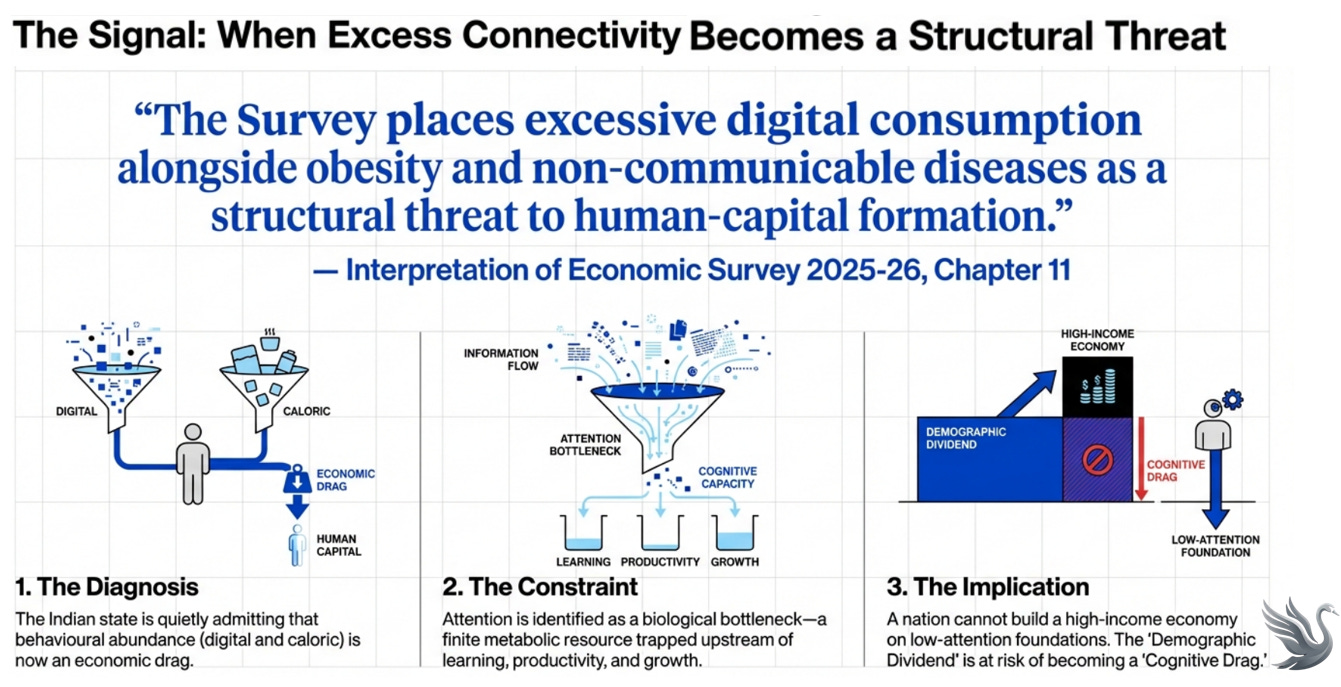
And that is why the most haunting signal in the Economic Survey 2025–26 is not a chart on fiscal arithmetic, nor a paragraph on exports. It is a sentence that should stop any serious reader bit cold: the Survey places excessive digital consumption in the same structural category as obesity and non-communicable diseases — a threat not to comfort, but to human-capital formation itself.
‘We lived on farms, then in cities, and now we will be living on the internet’ - they quoted this Dialogue from The Social Network; USA (2010)
The Great Inversion: When Access Becomes Adversary
That framing is unprecedented. Not because digital harms were unknown, but because the Indian state is now willing to name them as macroeconomic constraints. This is not lifestyle commentary. This is not parental anxiety dressed as policy. Rather Survey is quietly admitting that India’s next bottleneck is not the absence of infrastructure, but the degradation of the human node that infrastructure was built to empower.
Digital Overconsumption as 'Cognitive Ultra-Processing'
India’s youth are now living inside an intensely digital environment. Access has undeniably expanded learning, job discovery, and civic participation. But the Survey makes the crucial distinction: compulsive, high-intensity use imposes real economic and social costs.
Research on digital addiction now highlights a distinct and escalating risk profile among youth. The Economic Survey notes that social media addiction is strongly associated with anxiety, depression, low self-esteem, and cyberbullying stress — with both Indian and global studies confirming its high prevalence in the 15–24 age cohort.
Compulsive scrolling and algorithmic social comparison are not benign habits. They map directly onto rising anxiety and depressive symptoms.
Gaming disorder shows similarly concerning evidence: sleep disruption, aggression, social withdrawal, and depression — with adolescents particularly vulnerable to its grip.
Online gambling and real-money gaming introduce an even darker layer of harm, linked to financial stress, anxiety, depression, and in extreme cases, suicidal ideation.
And finally, the newest frontier of compulsion — streaming loops and short-video addiction — is associated with poor sleep hygiene, reduced concentration, and heightened stress. Endless video is not entertainment; it is extraction.
Taken together, the findings underscore the multifaceted nature of digital addiction — and its significant mental health consequences. What appears as “content consumption” is increasingly being recognized as a structural erosion of cognitive stability.
The Productivity Leak
The Survey goes further, pairing obesity and excessive digital consumption — explicitly framed as digital addiction — as a joint structural threat to India’s human capital and demographic dividend.
These are not treated as isolated lifestyle concerns. The Survey identifies them as interconnected, emerging public health challenges that undermine the physical, cognitive, and social development of the next generation.
Obesity is being driven in large part by the rising consumption of ultra-processed foods. But this nutritional shift is unfolding inside an environment where sedentary, screen-mediated lifestyles are becoming nearly ubiquitous.
The danger is compounded.
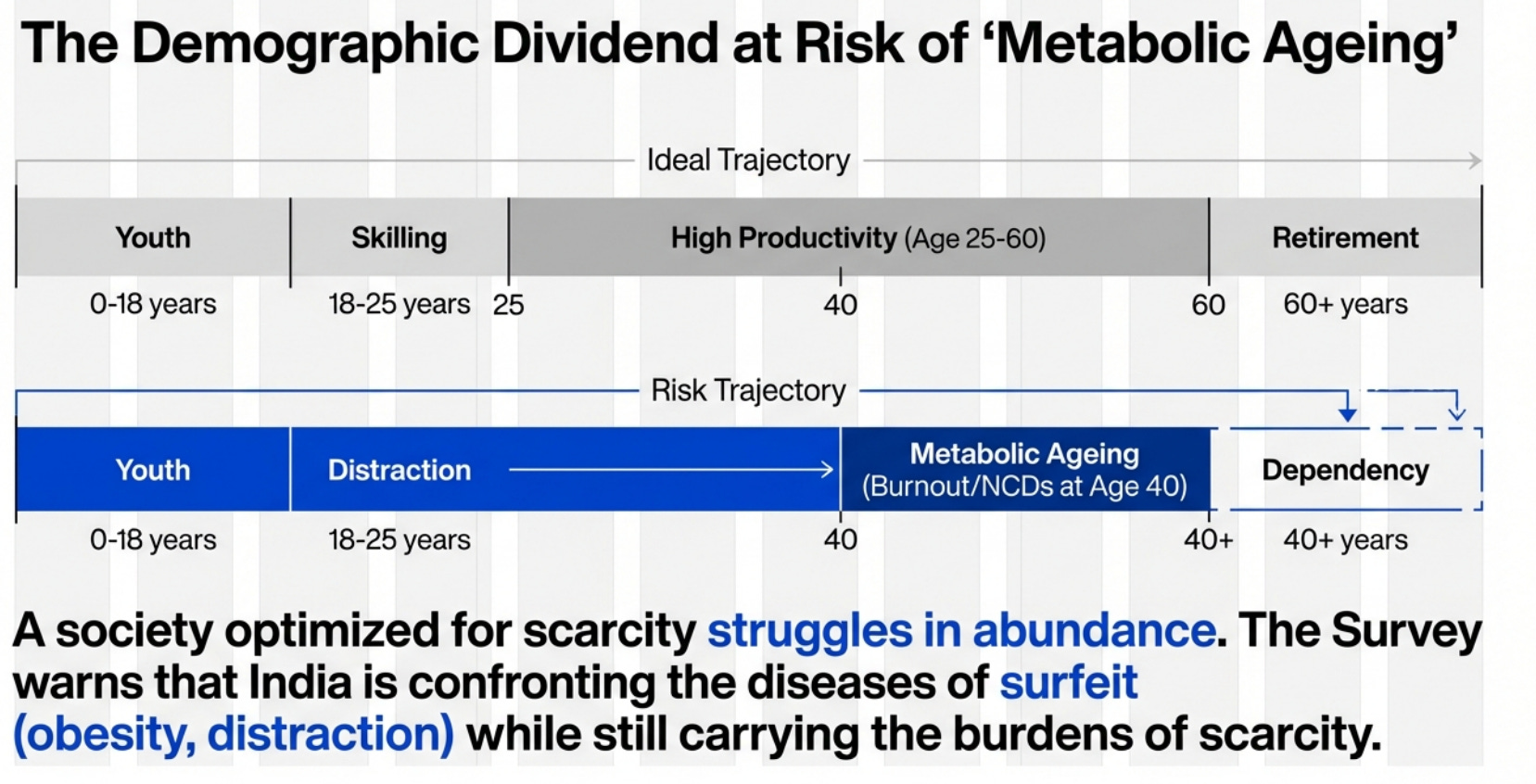
Excessive digital consumption erodes foundational cognitive capacities — deep learning, sustained attention, and psychological resilience. Obesity, meanwhile, accelerates the early onset of non-communicable diseases, weakening the biological base of productivity.
Together, they create a silent “productivity leak”: a slow drain on attention, health, and employability that risks turning India’s demographic dividend into demographic drag. Because human capital is not just schooling. Human capital is the conversion engine that turns:
time into skill
effort into productivity
youth into demographic dividend
learning into compounding
And attention is the upstream input to all of it.
Who Wins When Attention Becomes GDP
Attention is fast, reflexive, and effectively free. Capital, by contrast, compounds slowly and quietly. Capital wants persistence; attention thrives on novelty. When attention spikes, capital rarely leads. It follows—arriving not as a discoverer but as a rationaliser. Narratives are assembled after the fact to domesticate momentum: total addressable markets are expanded, secular trends are proclaimed, synergies are reverse-engineered. Explanation follows price, not the other way around. Attention arrives first; the thesis is written later to justify why it had to be right.
This is the illusion every attention-driven cycle produces: that visibility validated the idea. In reality, visibility merely forced capital to invent coherence around movement. Attention did not prove the thesis; it demanded one. Parts of the Indian digital economy have already lived through this dynamic—where spikes in searches, downloads, engagement, or outrage were mistaken for durable demand, and where valuation briefly confused reflexive attention loops with cash-flow-generating intent.
The problem is not attention itself. It is conversion. High-conversion attention reflects intent—searches that precede travel, commerce, or investment. Capital follows this efficiently. Low-conversion attention reflects habit, outrage, or algorithmic recursion—social feeds mistaking repetition for relevance. Here, capital follows noise and pays what can only be described as an attention tax. The market learns too late that attention is not capital; it is merely a signal, and often a distorted one.
Every era has a binding constraint that determines who compounds and who stalls. In the industrial age, it was steel. In the post-war age, it was oil. In the information age, it was bandwidth. Each constraint shaped not just economic power but institutional imagination. And now, in the attention age, the constraint is no longer material, logistical, or computational. It is biological. It is cognitive. It is the human mind’s ability to sustain focus, defer reward, and convert stimulation into skill.
India enters this phase with a distinctive—and fragile—configuration. Desire is abundant. Attention is cheap. But money remains conditional. Capital is released only when focus converts aspiration into capability, discipline into productivity, and learning into compounding output. This is a country that digitised faster than it industrialised, where smartphones arrived before stable middle-class incomes, and where digital public infrastructure scaled before behavioural insulation had time to form.
The result is a paradoxical digital dividend. India has unprecedented reach, platforms, and participation—but also unprecedented exposure to low-conversion attention. Engagement is high, monetisation uneven. Aspiration is visible everywhere; mastery is rarer. The risk is not that India lacks ambition. It is that ambition leaks through fragmented attention before it hardens into skill.
This is why the next decade will not be decided only by factories, exports, or fiscal arithmetic. It will be decided by whether the Indian mind can remain sovereign inside an engineered attention trap—one optimised for immediacy, fragmentation, and reflex. The demographic dividend is not automatic. It does not arrive simply because a population is young or connected. It must be earned cognitively.
It requires sustained focus in an environment designed to break it.
Deep learning in an economy addicted to surface signals.
Delayed gratification in an age that monetises instant fulfilment.
When attention itself begins to masquerade as GDP, the winners will not be those who capture the most eyeballs, trends, or spikes. They will be those—individuals, firms, and institutions—who can still command attention quietly, repeatedly, and over time.
The ultimate currency is not bandwidth. It is the undistracted minute.
India’s future will be decided not only by how many minds are connected, but by how many minds remain capable of depth.
Happy to get your views about this, or any other past posts.
Eye opener.
Brilliant analysis. The link between the Transformer paper and the current 'attention constraint' is so insightful. It really hammers home how valuable focused cognition is becaming, especialy with so much information available. It's almost an inverted problem now.