
The Inversion Point
When Yesterday’s Moat Becomes Tomorrow’s Cage.
Among my friends, I’m the ‘History Guy.’ It’s a title I earned—or perhaps was cursed with—after winning the national title of Tata Crucible back in 2018. They act as if that win, nearly a decade ago, granted me a permanent license to know everything about everything.
The trouble is, we often mistake past performance for future certainty. I was reminded of this recently by my eight-year-old son. He’s inherited the history bug, and during one of our recent deep dives, he brought up the Maginot Line.
Admittedly, I didn’t know much about it, so I did what I usually do: I went down the rabbit hole.
On paper, the Maginot Line was a masterpiece. After the trauma of World War I, the French built a defensive line that was a marvel of 20th-century engineering: concrete bunkers, retractable turrets, and sophisticated underground railways. They spent a decade and a fortune constructing what they believed was an impenetrable shield against German aggression.
It was perfect. But it was optimized for the last war.
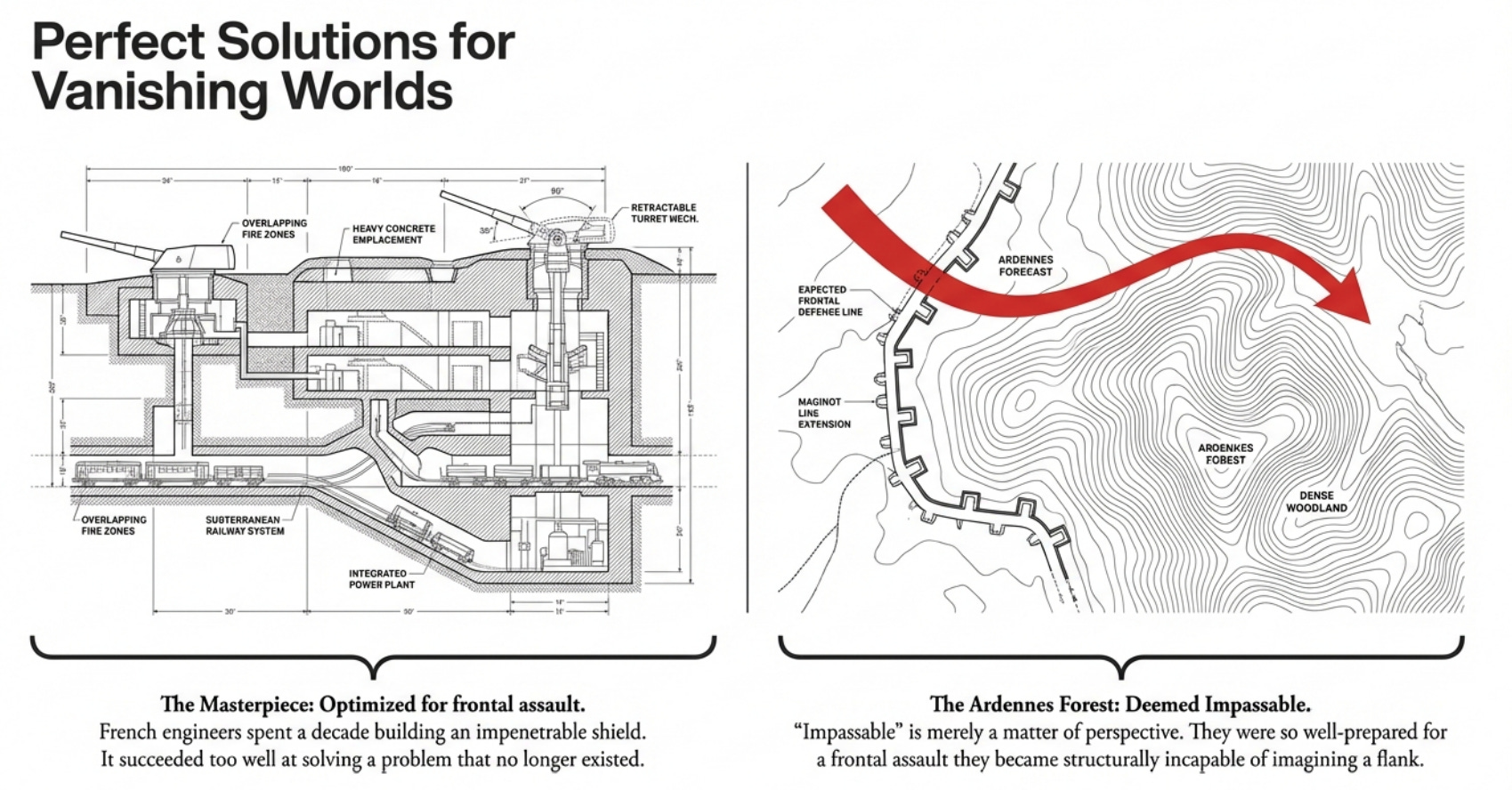
When the German army arrived in 1940, they didn’t bother attacking the line. They simply went around it, cutting through the Ardennes Forest—a region French generals had famously declared “impassable” for tanks.
It turns out, “impassable” is a matter of perspective.
The most sophisticated defensive system ever built became irrelevant not because it failed its design, but because it succeeded too well at solving a problem that no longer existed. The French were so well-prepared for a frontal assault that they became structurally incapable of imagining a flank.
I call this the Inversion Point - that precise moment when a system’s deepest strength—its most optimized feature—mutates into its most binding constraint. It is the point when/where our past successes become the walls of our future prison.
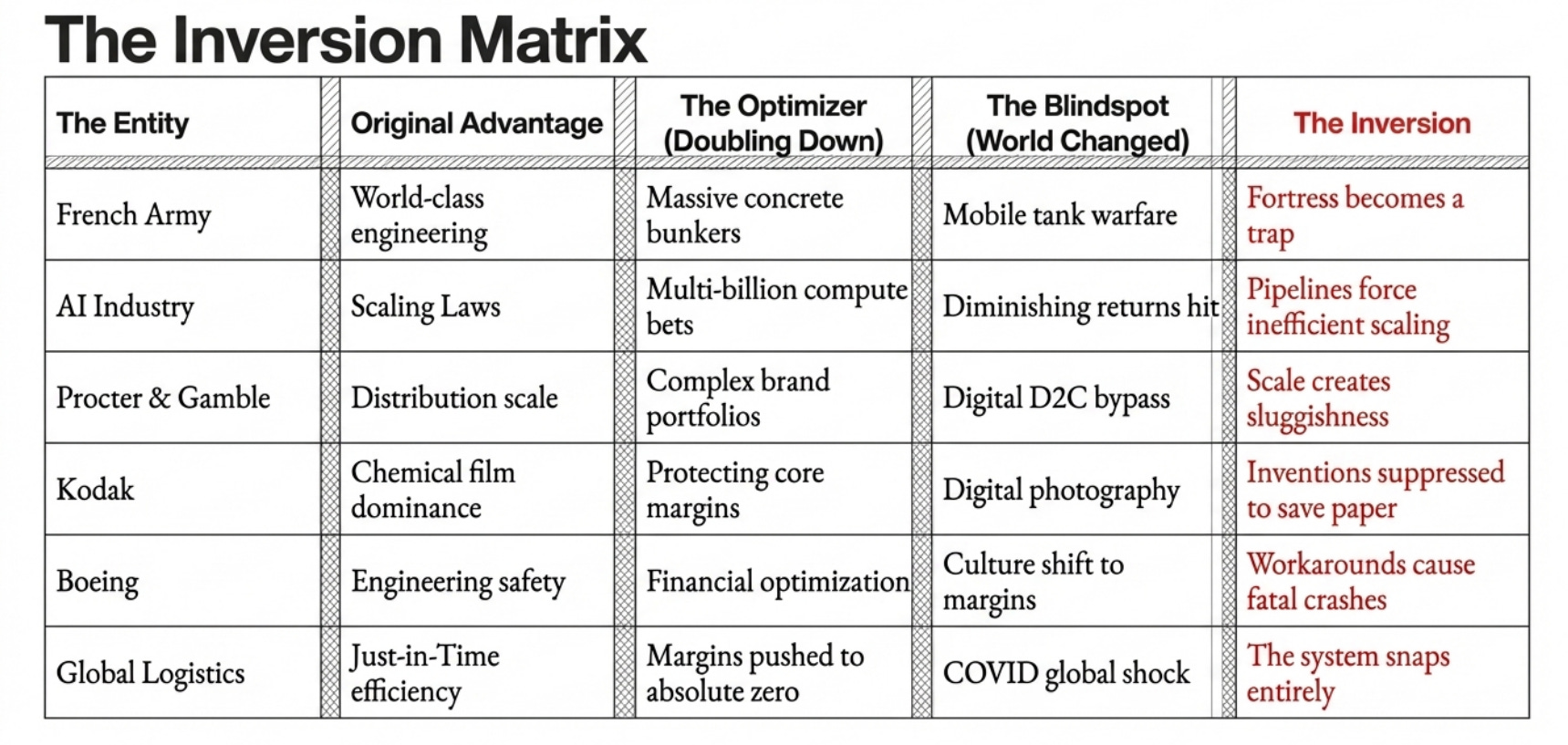
Even as I sit here, tempted to pull up the old 2018 winning photos, I see the same trap in the corporate world. We call it 'Best Practices.' We build massive, impenetrable processes around what worked five years ago—our own corporate Maginot Lines—while a startup in a garage is currently driving straight through our 'impassable' forest.
The Architecture of Advantage
Every successful system starts with one thing it does better than anything else.
For a company, maybe it’s scale. For an investor, a mental model that keeps finding mispriced assets. For a professional, deep expertise that commands a premium.
Early on, these advantages compound, pulling the organization toward tighter execution and total dominance. The system becomes a master of its own design.
But this is the hidden danger of The Second Order. Our first-order intent is always optimization—faster, bigger, more profitable. We celebrate these wins, but rarely account for the second-order ripple: every layer of optimization is also a layer of rigidity.
I’ve written before about The Mispricing of Scale—how the very size that protects an incumbent eventually becomes its greatest tax. When the environment is stable, scale is a moat. When the environment shifts, scale is just friction.
Look at the scaling laws in AI. For years, the industry operated on a simple faith: more compute and more data would yield more intelligence. OpenAI, Google, and Anthropic bet billions on this trajectory. But as returns diminished and the gain per unit of compute collapsed, these organizations found they couldn’t easily abandon the path. Their entire architecture—from fundraising to talent—had become structural.
This is the core of what I explored in The Physics of Value. We spent a decade believing “zero marginal cost” was a law of nature. But reality is stubborn. Eventually, the bill for physical constraints comes due, and a “software-only” mindset becomes the very wall that blinds us to the next shift.
The French engineers didn’t build a flawed Maginot Line; they built something perfectly adapted to a world that was about to end.
We do the same. We build our careers and portfolios around what worked, only to realize too late that we are clinging to a masterpiece while the environment has already moved on.
The Signal We Miss
The cruel thing about inversion is it never feels like decline. It feels like continued success.
In 2007, Nelson Peltz wrote a letter to Procter & Gamble’s board. He said the company had become a conglomerate trapped in a consumer products company’s body. Too many brands. Too much complexity. Too slow.
P&G’s response was understandable. They pointed to decades of consistent performance. Irreplaceable brands. Operational excellence that made them one of the most admired companies in the world.
By every conventional metric, they were right. The company was still growing. Still generating cash. Still dominating categories.
But the metrics were measuring the past.
Small, agile brands were using digital distribution to bypass retail gatekeepers. Dollar Shave Club didn’t beat Gillette on product quality. It beat them on business model. Gillette’s advantage—shelf space, media budgets, distribution muscle—had quietly become a liability. All that scale just made them slow.
P&G was optimized for a world that was disappearing.
Kodak is the classic case. They invented the digital camera in 1975. Their engineers knew exactly where technology was heading. But the company couldn’t act on that knowledge. Their entire profit model depended on film. On chemicals. On paper. Pursuing the future meant dismantling the present.
So they protected what they had until they had nothing left to protect.
This is the tragedy of missing the timing. In Climbing the Curve Before the Crown, I argued that the most critical moment to pivot is when you are at the peak of your powers—not when your crown is already slipping. Kodak waited until they were at the bottom of the curve, where the only thing left to manage was the decline.
The Internal Brick Wall
“The brick walls are there for a reason. … The brick walls are there to give us a chance to show how badly we want something. Because the brick walls are there to stop the people who don’t want it badly enough.”― Randy Pausch, The Last Lecture
For a successful organization, brick walls are internal. They are the accumulated structures of past success—the processes, the hierarchies, the “proven” models. From the outside, these walls look impassable, a fortress of market share.
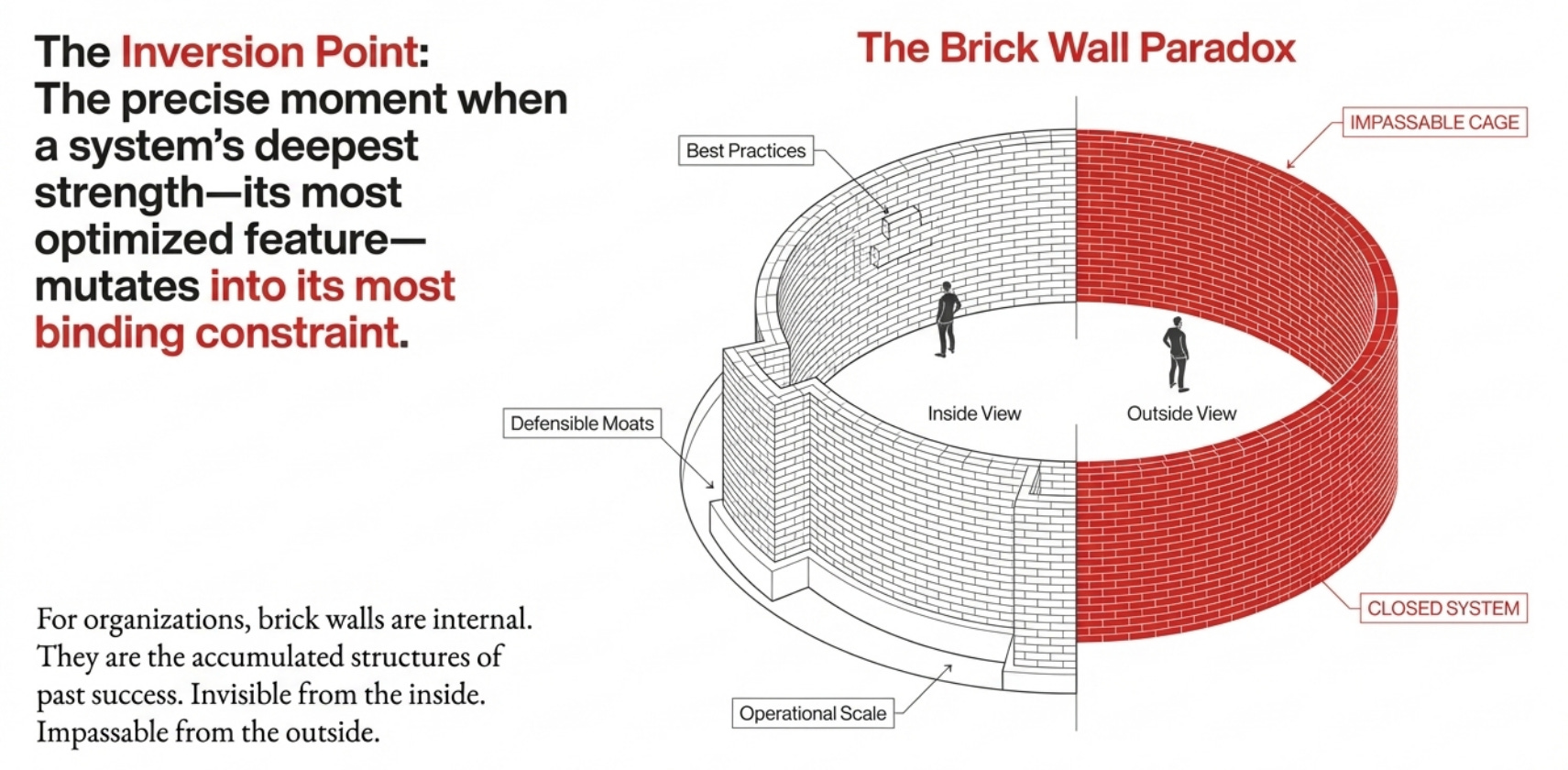
But from the inside, they are invisible. We don’t see them as barriers; we see them as the way things are.
We don’t realize we’re trapped until the world moves, and we find we can’t move with it.
When Strength Turns
The most dangerous thing an organization can have is a winning streak.
What makes you strong also makes you rigid.
Advantage leads to optimization. Optimization calcifies into rigidity. Rigidity yields to inversion.
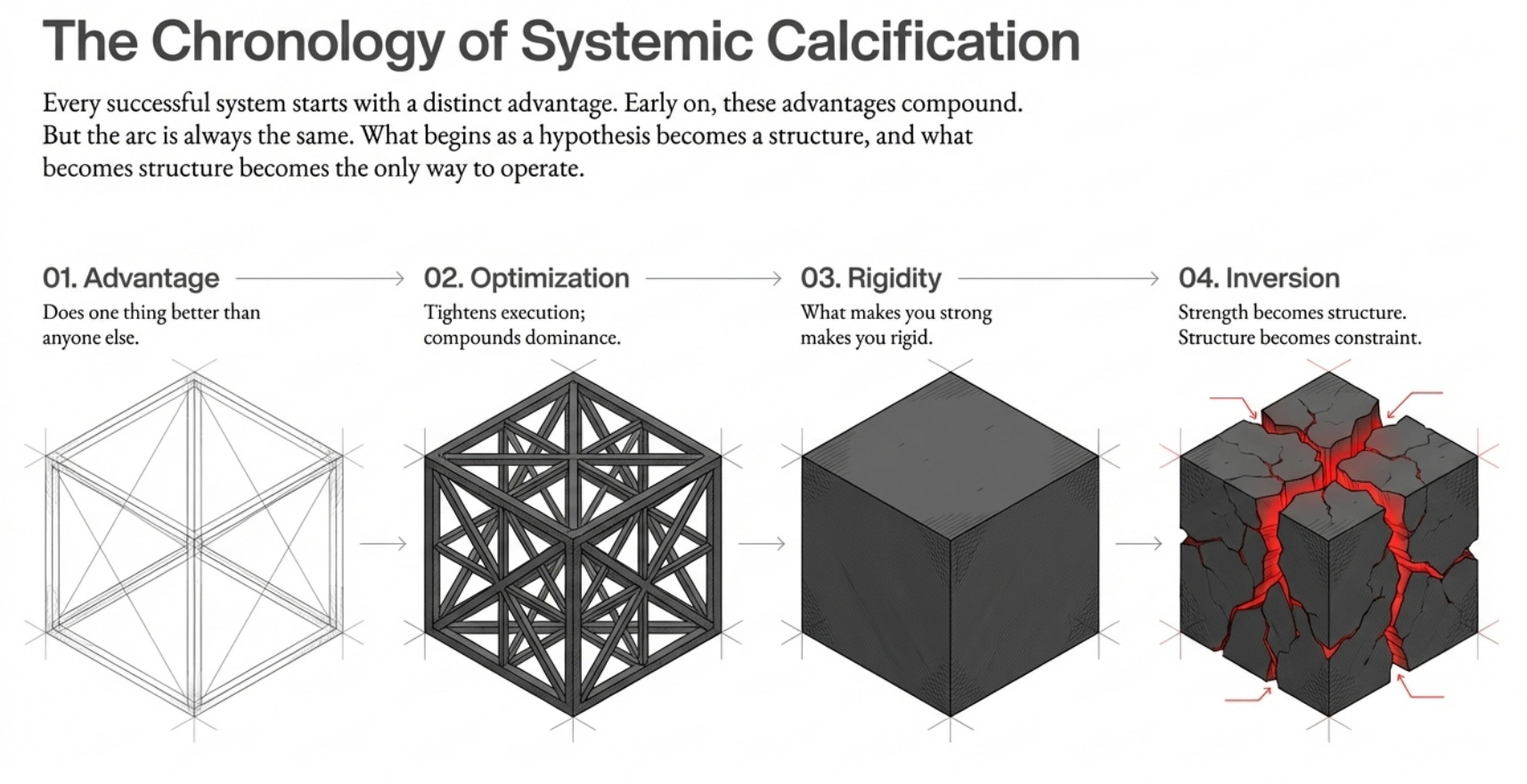
What starts as a strength eventually hardens into a structure. And once a structure is set, it becomes a constraint. You stop asking "What is the best way to do this?" and start asking "What is the way we’ve always done this?"
Take Boeing. For decades, their moat was a culture of obsessive, engineering-led craftsmanship. If you worked at Boeing, you were an artist of the air. Safety wasn’t a metric; it was a religion.
Then came the 1997 merger with McDonnell Douglas. The culture didn’t just change; it was colonized. The “best damn airplane” philosophy was traded for shareholder returns and quarterly targets.
The 737 MAX was the Inversion Point made of metal. The plane wasn’t designed to solve flight problems; it was designed to solve finance problems. It was a workaround—a digital patch called MCAS meant to avoid the “unnecessary” cost of retraining pilots. The advantage had inverted. The very pressure that once created the world’s safest aircraft was now being used to cut corners to meet a deadline.
By 2019, Boeing gave the shareholders the profits, but they couldn’t give the world a safe plane. The inversion was complete.
The Myth of the Clean Dashboard
This is why the biggest failures are rarely sudden. They are “delayed consequences”—debts from past successes that eventually come due.
We double down on what worked. We demand more scale, more efficiency, more “just-in-time” logic. In a vacuum, these decisions are brilliant. But they only work if the world stays exactly the same.
Supply Chains: We optimized them for decades until they were lean and profitable. Then COVID hit, and we realized “lean” just meant “brittle.” The system was perfectly designed for a world that had suddenly stopped existing.
LTCM: A group of Nobel laureates built a perfect model for fixed-income arbitrage. They had decades of data and leverage calibrated to the fifth decimal point. Then Russia defaulted, and the model failed. It didn’t fail because the math was wrong; it failed because the world refused to follow the math. The inversion point was invisible because, until the moment of the default, the dashboard was clean.
The most terrifying part of the Inversion Point is that it’s invisible from the inside.
If you look at the dashboard, everything looks fine. The dashboard was clean, but the foundation was already gone.
The Monument of the Present
The Maginot Line still stands—not as a defense, but as a warning. It is the perfect solution to a problem that ceased to exist. Let’s take another example- IndiaMart built a wall of listings, and AI simply drove around it.
IndiaMart and Justdial were first to the field in 1996, they built for the static web—optimizing for a world of directories and SEO. Alibaba arrived three years later but refused to stay a mere list of names. While the Indian incumbents polished their "first-mover" trophies, Alibaba evolved into a vertically integrated AI ecosystem. Today, with agents like Accio, Alibaba has bypassed the discovery layer entirely. IndiaMart, meanwhile, is suing OpenAI for "visibility"—a classic Inversion Point where a once-dominant directory becomes a structural cage in an AI-driven world.
We forget that every advantage has a breaking strain. Beyond that point, strength stops compounding and starts constraining. We optimize until we calcify, ignoring the one truth the French missed: Pressure can force better thinking, but only if the system is flexible enough to bend.
Survival in the next decade isn't about being the most specialized; it’s about being the most adaptable. Efficiency is a trap if it leaves you too rigid to bend.
Einstein warned that we cannot solve problems using the same logic that created them. He was describing the Inversion Point.
Success does not collapse. It inverts.
Lastly. Thank you for being part of this journey. This phase of my life has taught me that writing is the ultimate defense against the Inversion Point. It forces me to pay attention, to look past the dashboard, and to taste life twice: once in the moment, and once in the clarity of retrospect.
“We write to taste life twice, in the moment and in retrospect.” ― Anais Nin
Great writing. In the circumstances, what's the way forward recommended?
A well crafted post with a logical flow and explanation of how one's strength eventually becomes ine's greatest weakness. History is replete with examples:
1. Dinosaurs - the lumbring giants perished as their advantage of enormous size eventually flipped into a big weakness, viz., loss of agility
2. Britain's automotive industry - eventually lost out and shut down. Internal systems and processes relating to design changes, once a necessity to prevent chaos, eventually became so rigid and inflexible that the time lines and internal approal processes for ideation to implementation of improvements in component design, new vendor introduction and producion processes became a hurdle in quickly and nimbly adapting to rapidly evolving customer needs/preferences, emerging technologies etc. Bottom-line: strength ossified into rigidity with disastrous consequences.