
The Second Order
Why the only move that matters is the one nobody planned for.
Charles Perrow, in his theory of “normal accidents,” argued that in complex systems disasters are not anomalies—they are inevitable. When many components interact tightly and rapidly, small failures collide, cascade, and amplify in ways no designer can fully predict. The catastrophe, when it arrives, looks shocking. In retrospect, it was structurally unavoidable.
“Complex systems fail in ways that are difficult to anticipate because their interactions are not visible.” — Charles Perrow
But the same logic applies not only to failures—but to progress. Complex systems do not just produce unexpected disasters. At time, they also produce unexpected breakthroughs.
In 1854, a physician named John Snow drew a map. Not of continents or coastlines—but of deaths. Cholera deaths, plotted street by street across London's Soho district. He was trying to solve a drainage problem. Contaminated water. A single pump handle on Broad Street.
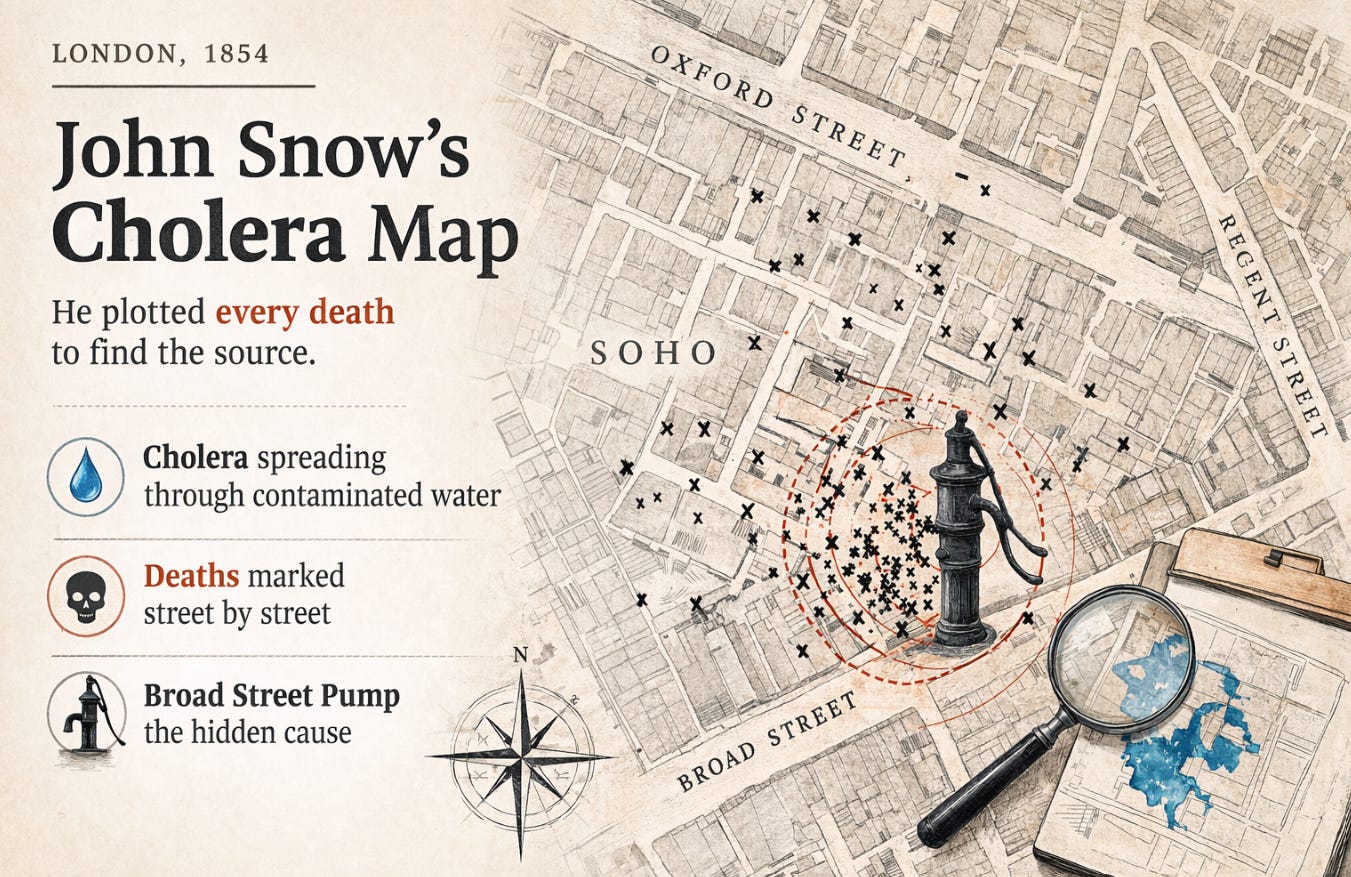
He had no idea he was inventing epidemiology. More on this here
He had no idea that his map—a tool to stop one outbreak—would become the intellectual ancestor of every contact-tracing app, every disease surveillance system on the planet.
He just wanted to stop people from dying on his street.
That is the nature of the Second Order. Quietly. Disguised as something much smaller. Not as revolutions, but as practical solutions to ordinary problems.
The Pattern History Keeps Repeating
When you look closely at history, a strange pattern appears. The inventions that reshape civilization rarely begin with grand ambitions. Their creators are usually trying to solve something narrow, practical, and immediate.
The first-order problem is almost always mundane—the small friction sitting right in front of the inventor.
But once that solution enters society, it interacts with countless other systems—economic, political, cultural. And that is where the second order emerges: the deeper consequences no one was trying to create, and no one fully saw coming.
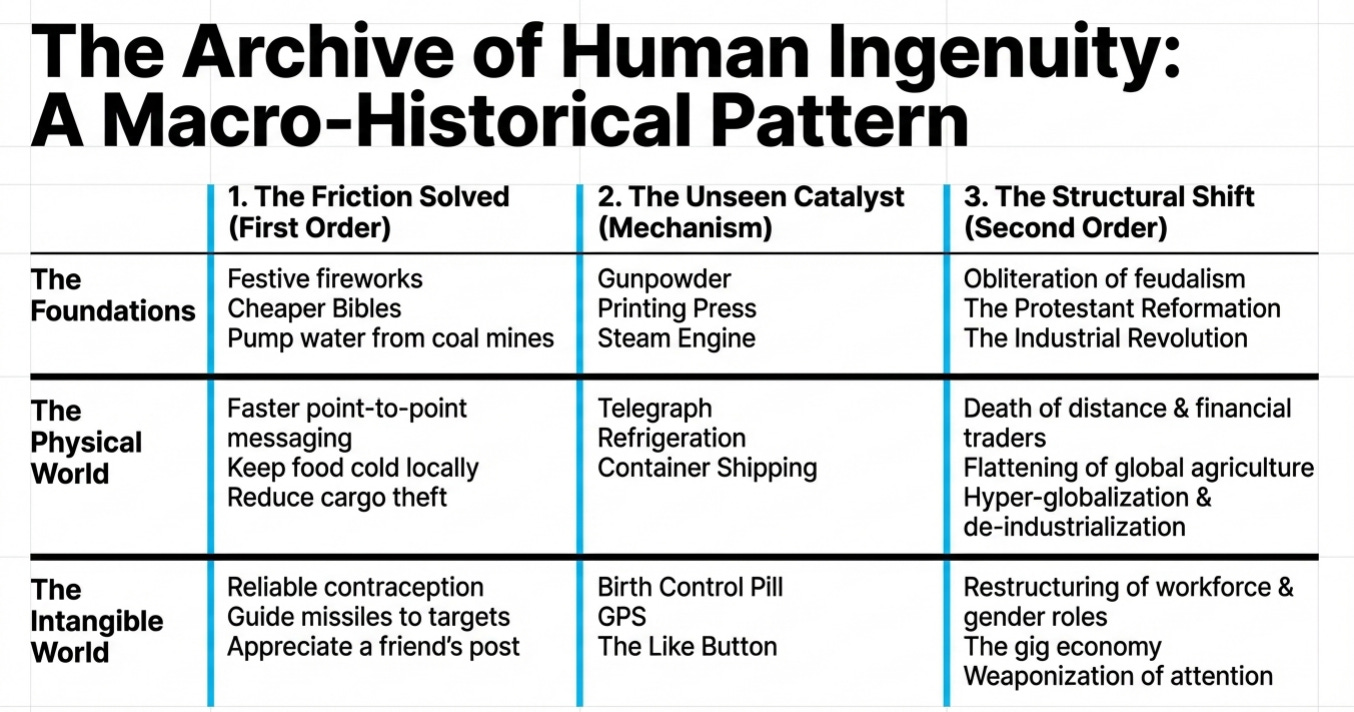
Once you notice the pattern, you start seeing it everywhere.
Again and again, world-changing technologies begin as solutions to surprisingly ordinary problems. The inventor focuses on the immediate friction. Society deals with the ripple effects later.
A quick tour through the archive of human ingenuity makes the point:
Gunpowder.
First Order: Festive fireworks.
Second Order: The obliteration of feudalism. The armored knight and the stone castle rendered obsolete overnight. State power centralized. European colonialism made structurally possible.
The Printing Press.
First Order: Cheaper Bibles.
Second Order: The Protestant Reformation. The fracturing of Christendom. The birth of the modern author. The scientific method. Martin Luther did not get a memo.
The Steam Engine.
First Order: Pump water out of coal mines.
Second Order: The Industrial Revolution. The factory. The railway. Populations uprooted from fields into cities, never to return.
“Revolution doesn’t happen when society adopts new technologies—it happens when society adopts new behaviors.” ―Clay Shirky
The Telegraph.
First Order: Faster point-to-point communication.
Second Order: The death of distance. For the first time, information outran a horse. This synchronized global markets, standardized time zones, and created the modern financial trader.
Refrigeration.
First Order: Keep food cold locally.
Second Order: The flattening of global agriculture. Chicago became the butcher of the world. New Zealand supplied lamb to London. The bond between local climate and local diet was permanently severed.
The Birth Control Pill.
First Order: Reliable contraception.
Second Order: The restructuring of the workforce, gender roles, and family economics across the developed world. One small pill rewrote the social contract.
Container Shipping.
First Order: Reduce cargo theft. Speed up loading.
Second Order: Hyper-globalization. By collapsing the cost of moving goods, it made planetary supply chains economically rational. The West de-industrialized. Asia industrialized. A steel box reshaped the world order.
GPS.
First Order: Guide missiles to their targets.
Second Order: The trust layer of the modern economy. It enabled the gig economy—Uber, DoorDash. It synchronized financial transactions. It made just-in-time logistics possible. The missile guidance system now tells you where to get dinner.
The Gap Is Narrowing. The Impact Is Widening.
The pattern continues into recent history—but with a disturbing twist. The gap between First Order intent and Second Order consequence is shrinking in time while expanding in scale. What once took centuries now takes years.
The Like Button.
First Order: A quick way to appreciate a friend's post.
Second Order: The weaponization of attention. A dopamine loop optimized for outrage. Political polarization normalized. A teen mental health crisis still being mapped. All from a thumbs-up icon.
Cryptocurrency.
First Order: Peer-to-peer cash, free from central banks.
Second Order: A new speculative asset class. Internet-native finance. An environmental debate. And—ironically—the perfect vehicle for ransomware payments. Satoshi did not include that in the white paper.
AI Language Models.
First Order: Better chatbots. Smarter search.
Second Order: The commoditization of creativity. The white-collar world now faces the same structural disruption the blue-collar world absorbed in the 1980s. Writing, coding, design—simultaneously democratized and economically devalued. The implications are still arriving.
Four Rules for Living in the Second Order
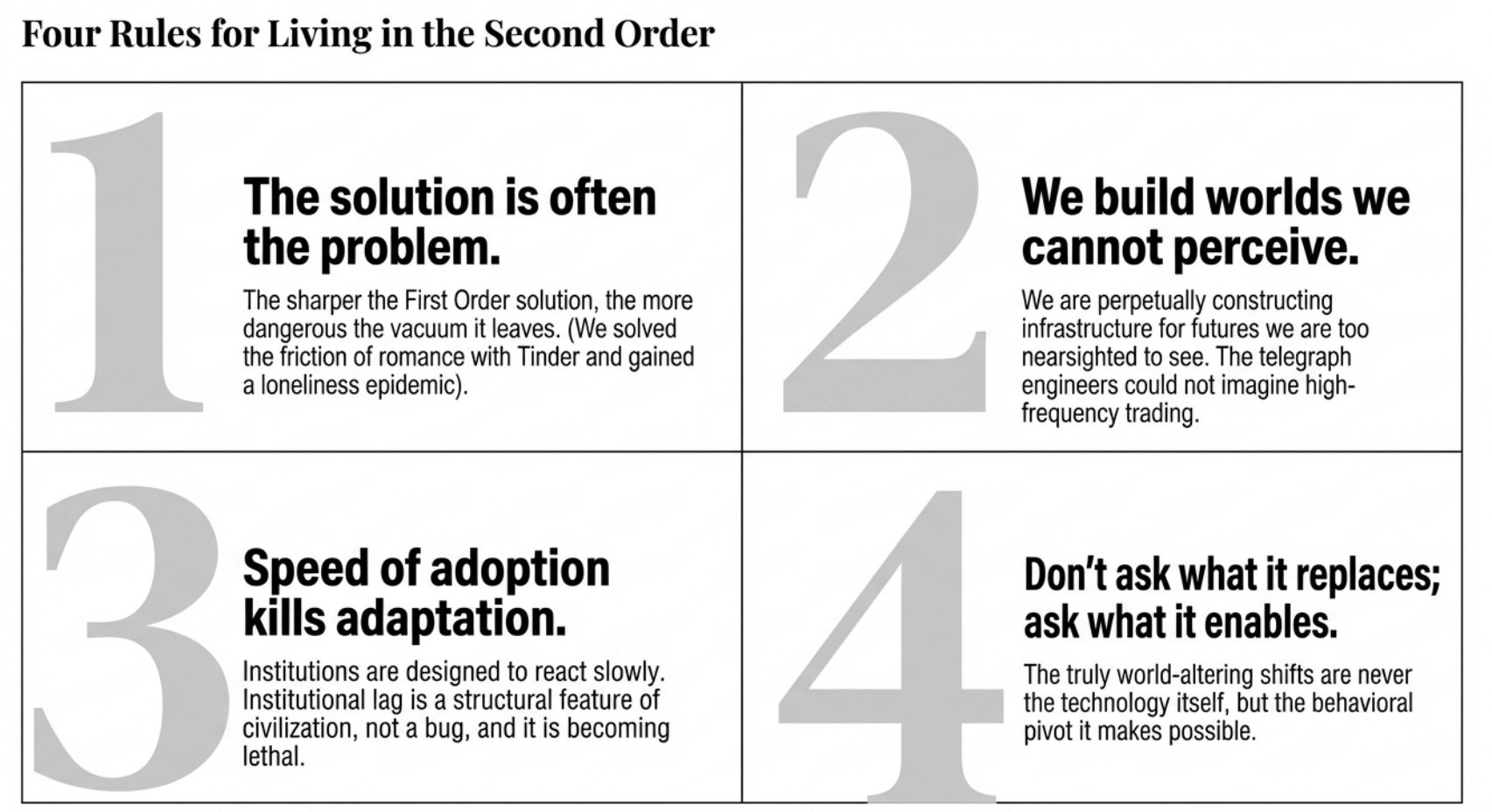
If the Second Order is where the real impact lives, the practical question becomes: how should we think in a world where consequences outrun intentions? Prediction helps less than we think. Patterns help more. Across centuries of innovation—from gunpowder to AI—the same structural dynamics appear again and again. Solutions create vacuums. Technologies reshape behavior. Systems accelerate faster than societies can adapt. These patterns suggest a few simple rules for navigating a world where the biggest effects are always the least obvious.
1. The solution is often the problem.
When you solve a friction point perfectly, you create a vacuum. We solved the friction of finding romance (Tinder) and ended up with a loneliness epidemic. We solved the friction of finding answers (Google) and ended up with an attention economy that profits from misinformation. The sharper the First Order solution, the more dangerous the vacuum it leaves.
2. We are always building a world we cannot perceive.
The inventors of the steam engine could not imagine suburban sprawl. The engineers of the telegraph could not imagine high-frequency trading. Today, someone in a lab is tweaking a neural network—and is not imagining the geopolitical balance shifting in 2040. But they are building the mechanism for it. We are perpetually constructing infrastructure for futures we are too nearsighted to see.
3. Speed of adoption kills adaptation.
Gunpowder took centuries to reshape Europe. The printing press took a generation. AI is reshaping the labor market in months. The gap between First Order and Second Order is collapsing. Our institutions—governments, education, regulation—are designed to react slowly. They are attempting to regulate a world the telegraph built, while we live in a world the smartphone built. The lag is not a bug. It is a structural feature of civilization. And it is getting more dangerous.
4. Don't ask what it replaces. Ask what it enables.
The truly world-altering shifts are never in the technology itself. They are in the behavioral pivot the technology makes possible. When evaluating any new technology, the productive question is not: "What does this disrupt?" It is: "What new human behavior does this make possible that was impossible yesterday?"
The Map and the Outbreak
Let us return to John Snow and his map.
When he removed the handle from the Broad Street pump, the cholera outbreak stopped. He solved the problem in front of him. That was the First Order.
But the method he deployed—spatial reasoning, data visualization as a tool of public argument—became the foundation of modern epidemiology, urban planning, and data-driven decision-making. That was the Second Order. It is still compounding today.
He just wanted to stop people from dying on his street.
That is always how it begins.
Nobody is looking at the map they are drawing.
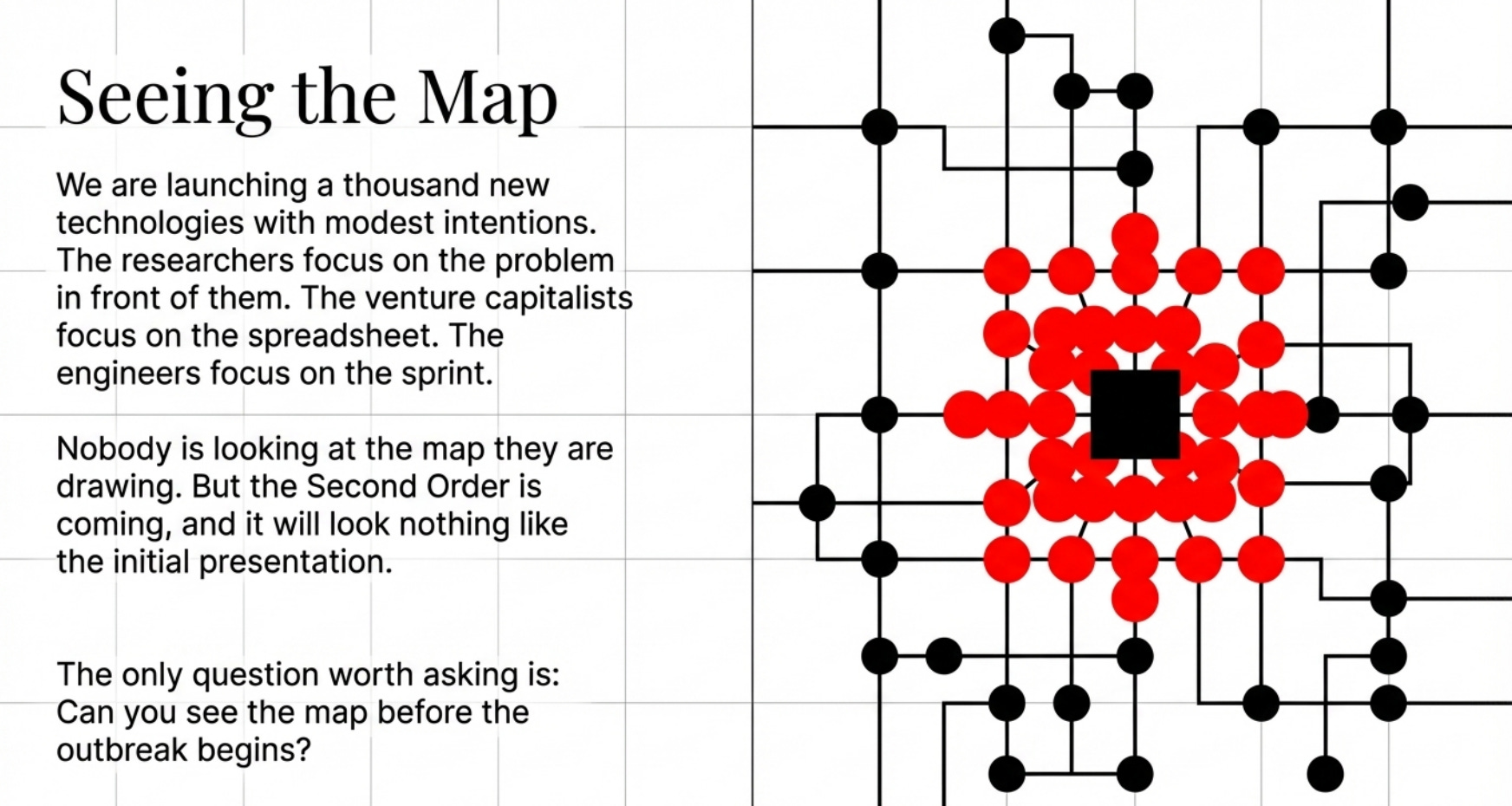
The only question worth asking—as an investor, a builder, or simply a citizen of the future: can you see the map before the outbreak begins?
The future is rarely invented on purpose. It is usually the side effect of someone trying to solve a much smaller problem.
Thought provoking write up
absolutely brilliant analysis.....and also exceptionally accurate