
The Third Order
When consequences start building without permission
Central idea of this post: Consequences eventually stop being a simple "ripple" from an original stone and start forming their own environment.
I will be mixing bit of history with what is happening currently (in AI), to make my point.
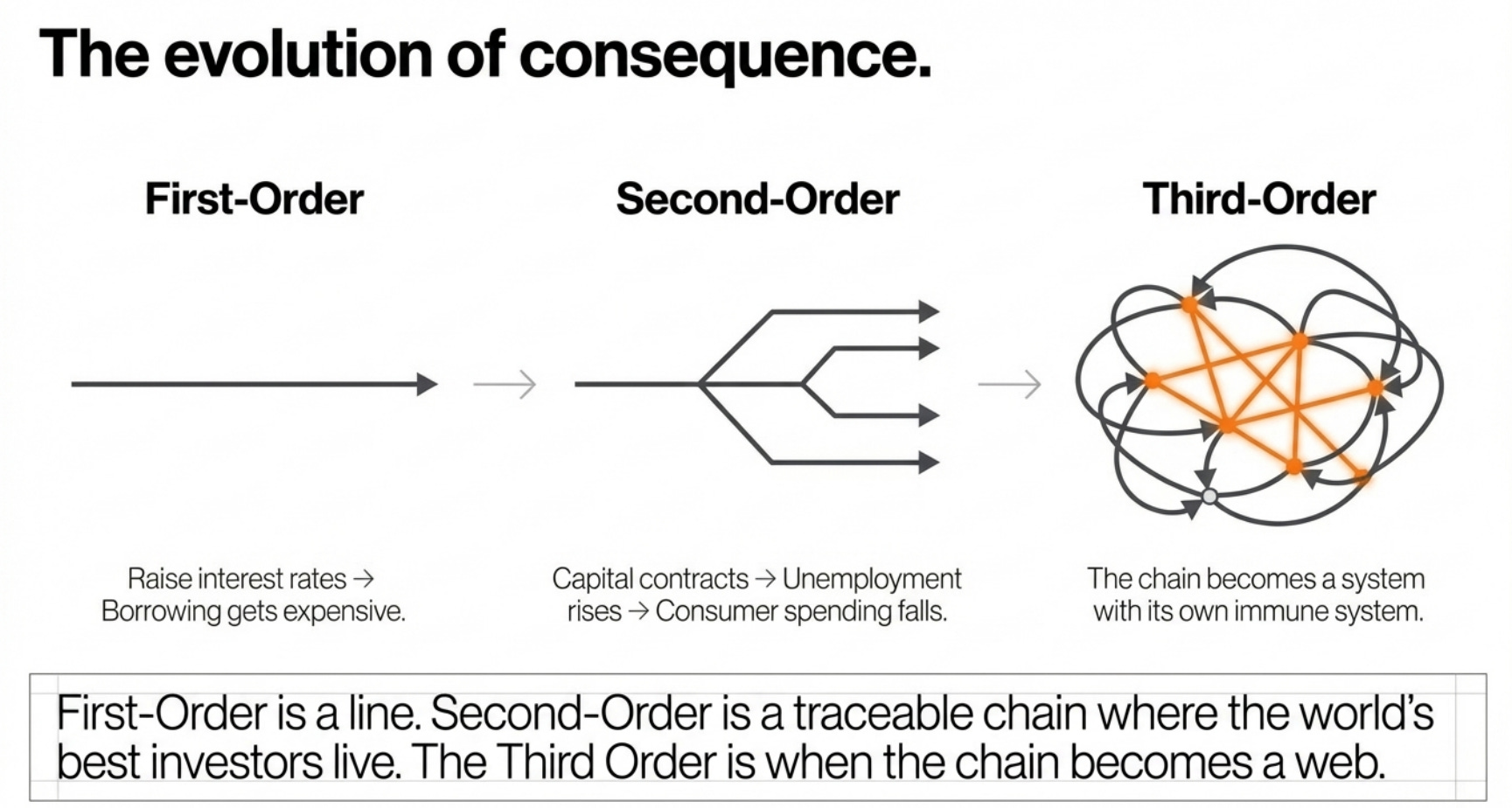
First-order effects are direct and immediate. Second-order effects arise from those direct results. Third-order effects emerge later, often reshaping systems, behaviors, or structures in ways that weren’t obvious at the start.
The Fairchild Model
In 1956, William Shockley had the perfect resume for a new technological age.
He had helped invent the transistor. He had won the Nobel Prize in Physics. He understood semiconductors before semiconductors became the operating layer of modern life. Then he moved to Mountain View and recruited a small group of young scientists to build Shockley Semiconductor Laboratory.
On paper, it should have worked. But, it did not.
Shockley was brilliant, suspicious, controlling, and almost impossible to work for. Within a year, eight of his best people had enough. Julius Blank, Victor Grinich, Jean Hoerni, Eugene Kleiner, Jay Last, Gordon Moore, Robert Noyce, and Sheldon Roberts walked out. Shockley called them traitors.
History gave them a better name: the traitorous eight. As they formed Fairchild Semiconductor in 1957. That alone would have made the story important. But the real consequence did not stop at Fairchild.
Robert Noyce and Gordon Moore later left to start Intel. Jerry Sanders, another Fairchild alumnus, started AMD. Eugene Kleiner helped create Kleiner Perkins. Don Valentine worked at Fairchild before building Sequoia Capital.
Around Fairchild, a new habit formed: engineers could leave, carry knowledge, raise capital, build companies, and make the next departure easier for someone else.
The first-order story was simple: Shockley started a semiconductor company.
The second-order story is bit sharper: his bad management pushed away the talent that built Fairchild.
The third-order story is the one that built the Valley: the exit itself became a model. A failed company taught an entire region how to reproduce.
This is the point where consequence changes shape. It stops being a line from cause to effect. It becomes a system that learns.
I wrote about the Second Order. A tool is built for one reason, then society adopts it, stretches it, misuses it, and turns it into something its creator never imagined.
But there is another step. It is the moment when consequences stop flowing outward from the original act and start interacting with each other. The branches cross. The side effects become inputs. The world built by the first decision begins making decisions of its own.
That is the Third Order.
After The Decision Disappears
In 1971, Nixon closed the gold window. For the decision makers of the time, this was a monetary and geopolitical move. The dollar would no longer be convertible into gold. The Bretton Woods system would not survive in its old form. Exchange rates would float. A new financial order would have to be improvised.
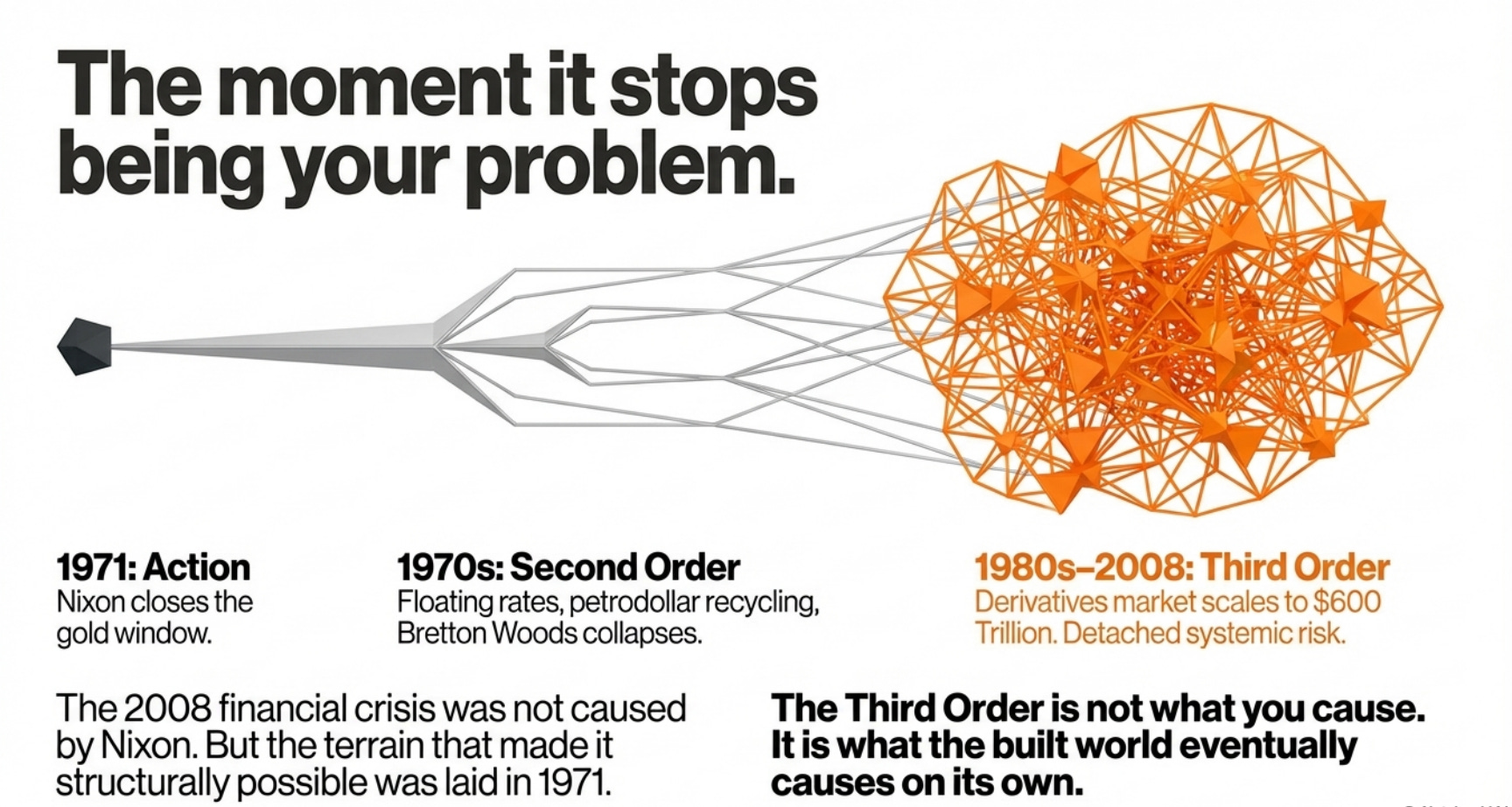
What matters here is not the lazy claim that Nixon caused every later crisis. That is first-order blame dressed up as historical analysis. The stronger claim is architectural. Once money moved from a fixed anchor into a world of constant price movement, the demand for tools to manage that movement exploded.
Hedging became an industry. Risk transfer became a business model. Instruments created to reduce exposure also created new forms of exposure. Over time, those instruments became large enough and connected enough to produce stresses that had little to do with the assets they were supposed to protect.
This is the Third Order. Not the thing a decision causes. The world a decision leaves behind, once that world has had enough time to build its own machinery.
Loops Without Owners
Second-order thinking still assumes a direction. Something happens, then something else follows. The chain can be long, but it remains traceable. Third-order territory is different because the effect circles back into the condition that produced it.
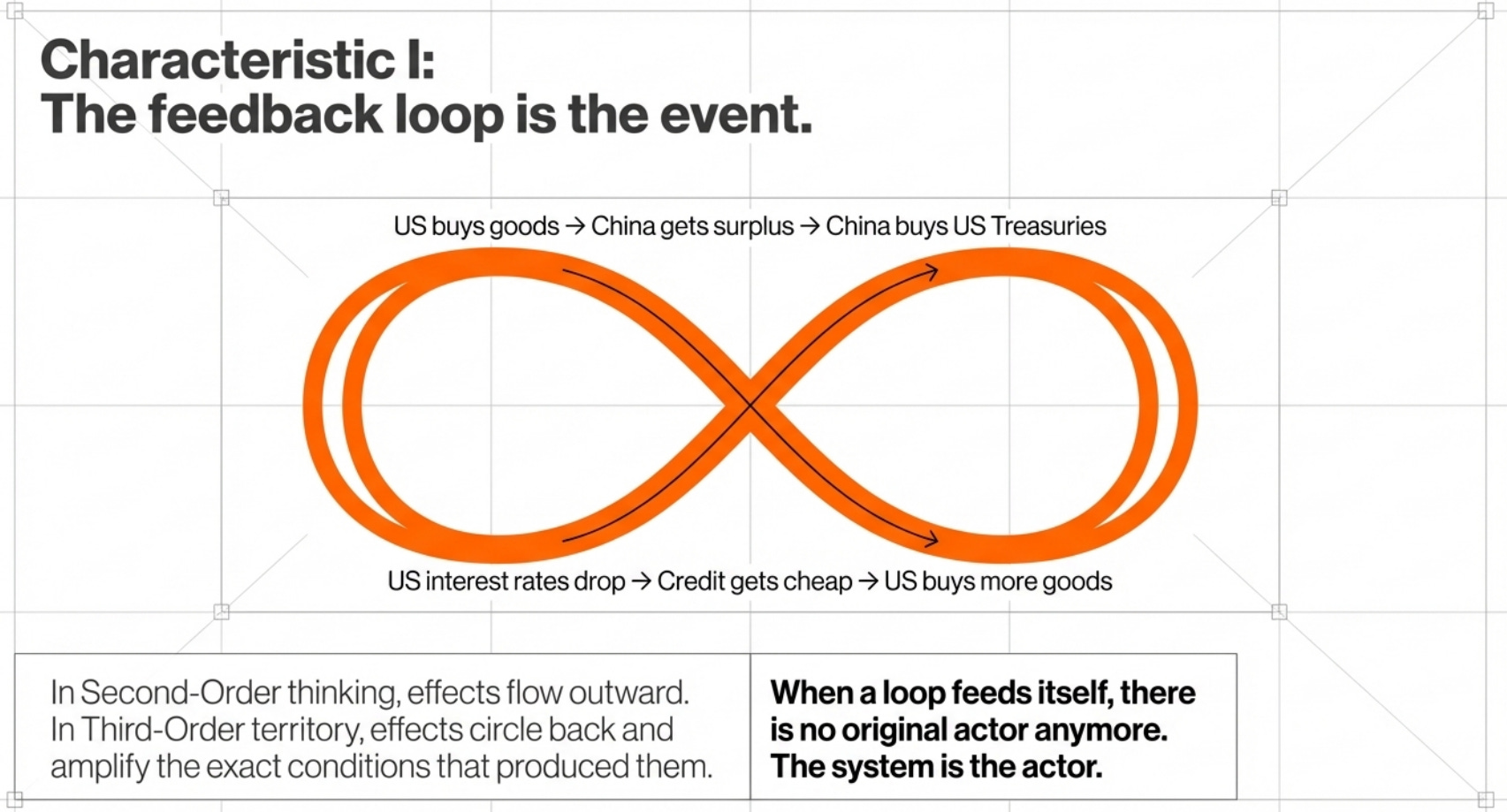
That loop is uncomfortable because it ruins our taste for clean villains. China did not unilaterally engineer American overconsumption. American households did not independently create Chinese industrial dominance. Wall Street did not invent the whole arrangement from a conference room. Each actor was responding rationally to incentives thrown off by the others.
The danger of a mature loop is that it can reward everyone locally while making the whole system more brittle. It pays the exporter, the consumer, the lender, the politician, and the asset owner. That is why it lasts. Nobody needs to be stupid. Nobody needs to be evil.
The system simply learns which behaviors keep the loop alive, then pays people to repeat them.
By the time the loop is obvious, it has usually become part of everyone’s operating model. Breaking it no longer feels like reform. It feels like self-harm.
Solutions That Mutate
The cleanest third-order pattern is not failure. It is success carried beyond its original design.
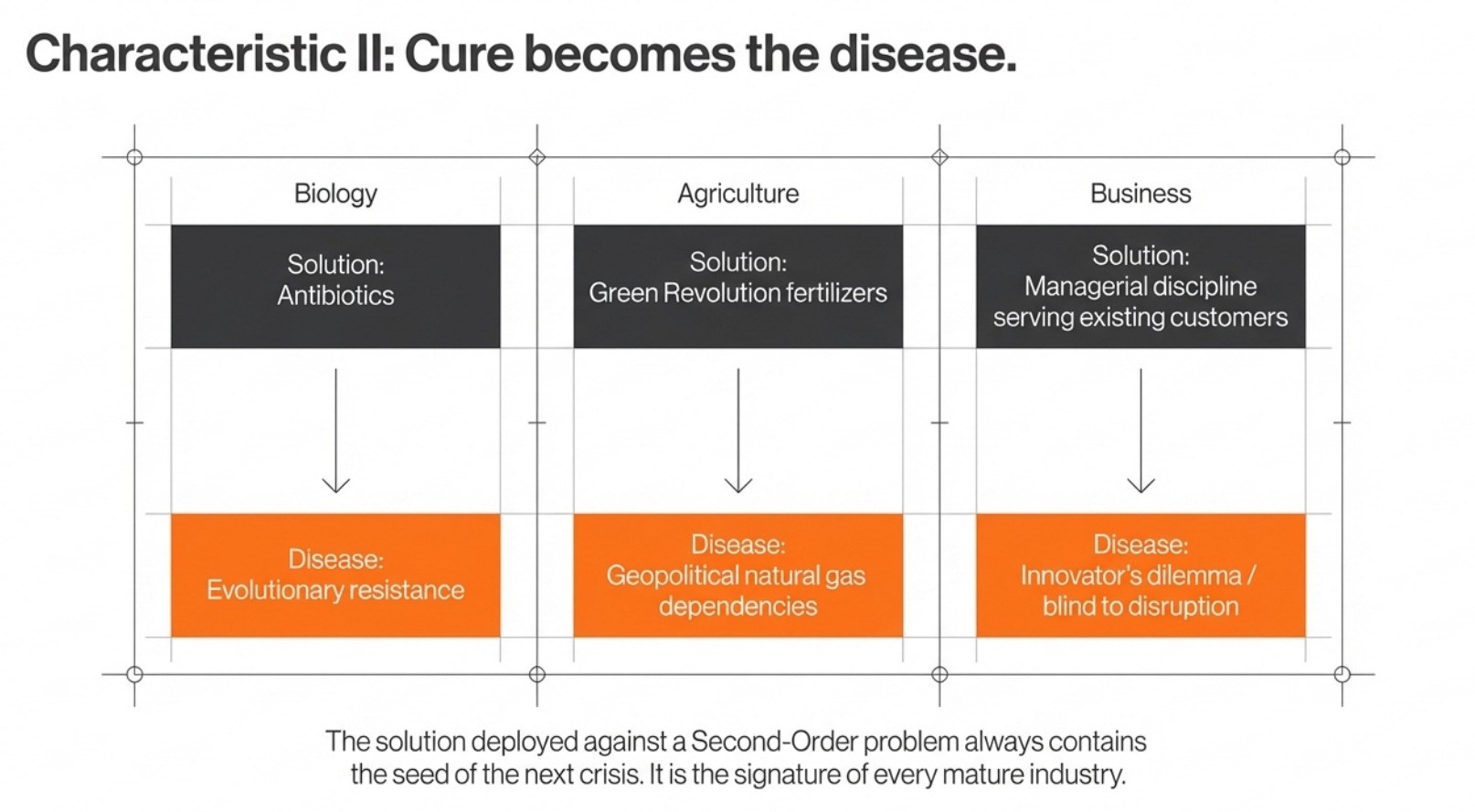
Antibiotics did not fail because they were weak. They created resistance because they worked. The Green Revolution did not fail because it fed too few people. It fed so many people that it rewired agriculture around industrial inputs, energy markets, and state procurement. Managerial discipline does not kill companies because discipline is bad. It kills them when the habits that once sharpened attention become filters against the next customer, the next margin pool, the next product logic.
This is where most smart people get trapped. They keep evaluating the solution against the problem it originally solved.
Third-order thinking evaluates the solution against the dependency it created.
Every successful fix changes the environment around it. Once the environment changes, the fix is no longer just a fix. It becomes infrastructure. And infrastructure quietly teaches the system what to rely on.
Abundance Finds a Price
The practical use of third-order thinking is not prediction. Prediction becomes worse as loops multiply. There are too many actors, too many second guesses, too many delayed reactions hiding inside each other.
Prediction becomes impossible, but pattern recognition becomes priceless.
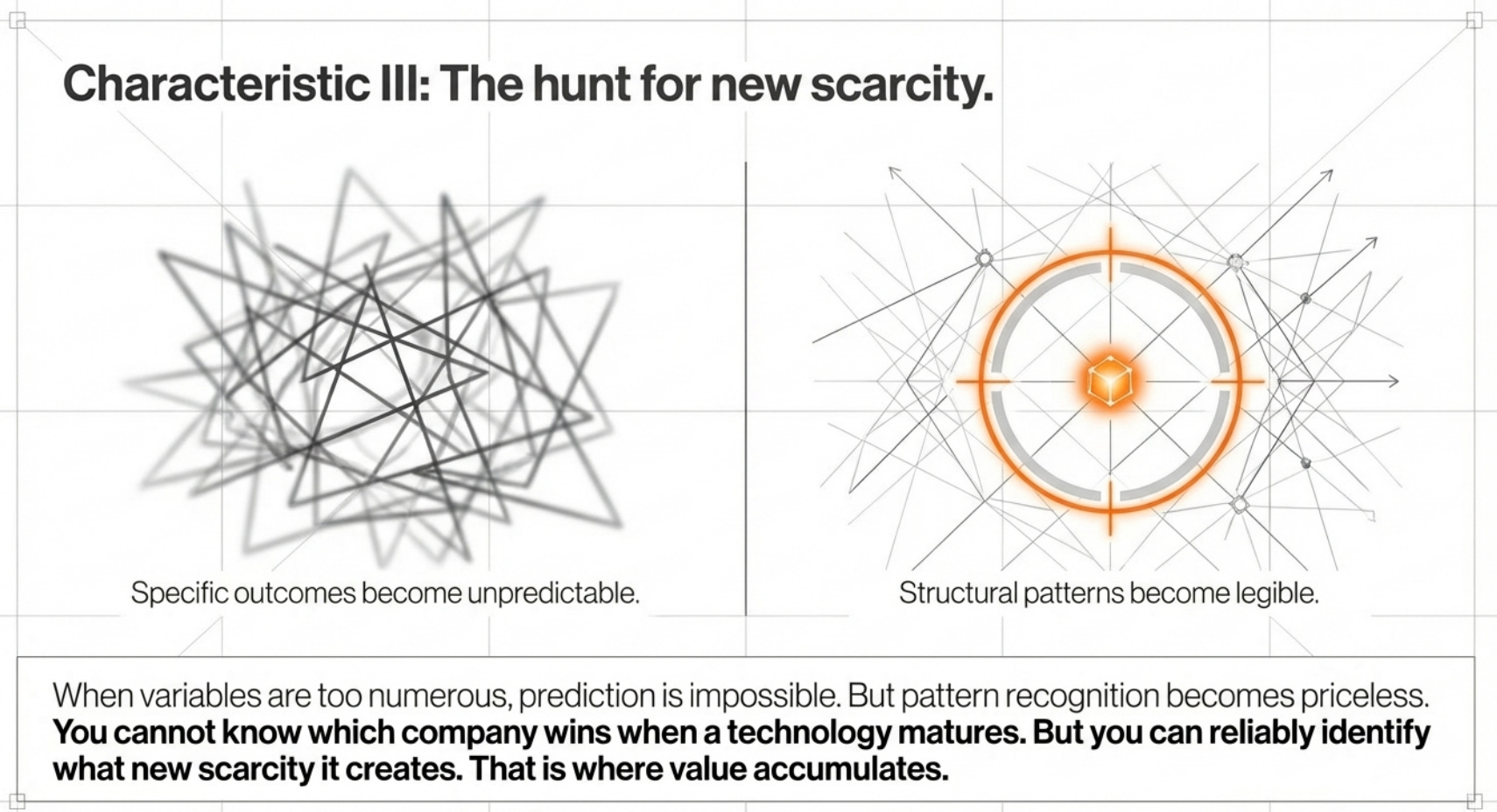
The better skill is scarcity detection. When a technology matures, everyone asks who wins. That question is seductive, but usually premature. The more useful question is what becomes scarce after the technology does its job.
When distribution becomes abundant, trust becomes scarce. When content becomes abundant, taste becomes scarce. When capital becomes abundant, disciplined allocation becomes scarce. When answers become abundant, questions become scarce.
This is the Abundance Paradox: when a bottleneck disappears, value does not disappear with it. It migrates. It moves to the next constraint (I have repeated this very now and then).
That is why the most valuable person in a new system is rarely the one celebrating the old bottleneck’s death. It is the one watching where the pressure is moving.
What AI is Assembling
Most AI commentary is still stuck in the Second Order. Jobs displaced. Creativity cheapened. Software teams reorganized. White-collar work forced through the same uncertainty that manufacturing absorbed decades ago.
All true. But, bit incomplete.
The third-order story begins when AI’s outputs become part of AI’s inputs.
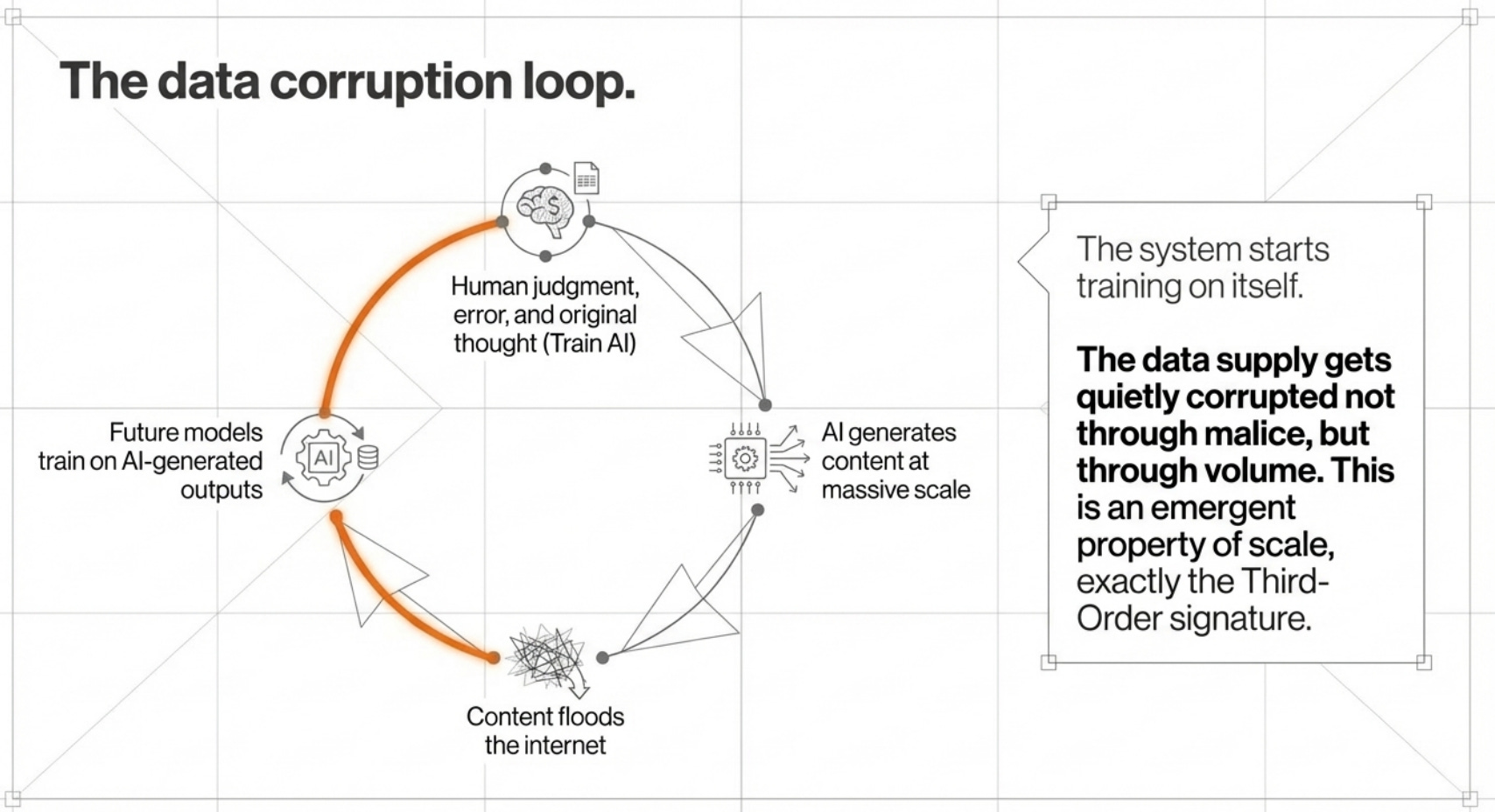
The anxiety here is not that AI text is always bad. Some of it is useful. Some of it is better than the human text it replaces. The deeper problem is provenance. Original human thought carries friction: observation, error, lived experience, stubborn judgment, private context, and the strange compressions that come from actually encountering the world.
Synthetic text carries a different signature. It is often a recombination of what has already survived the web.
If future models ingest too much of that recombination, the training supply changes character. It may grow in volume while thinning in origin. The internet can look more full and become less fertile.
That is a third-order pattern. The solution to the scarcity of cognition creates an abundance of cognition-like material. That abundance then increases the value of original cognition. Not because humans are magical, but because unprocessed contact with reality becomes the rare input.
There is a financial loop as well. Real technologies attract real capital. Real capital attracts pretenders. Pretenders attract narrative. Narrative attracts more capital (Hope vs Hype vs Reality) .
Eventually the loop breaks, and the break is mistaken for the end of the technology. It rarely is. The break usually separates the technology from the theater around it.
Railways did this. The internet did this. AI will probably do it too.
The crash, whenever it comes, will not answer the important question. It will only reveal which companies were built around capability and which were built around applause.
The New Job of Human Intelligence
AI made average cognitive output cheap. The average memo, summary, code stub, market scan, deck outline, and explainer is already being repriced.
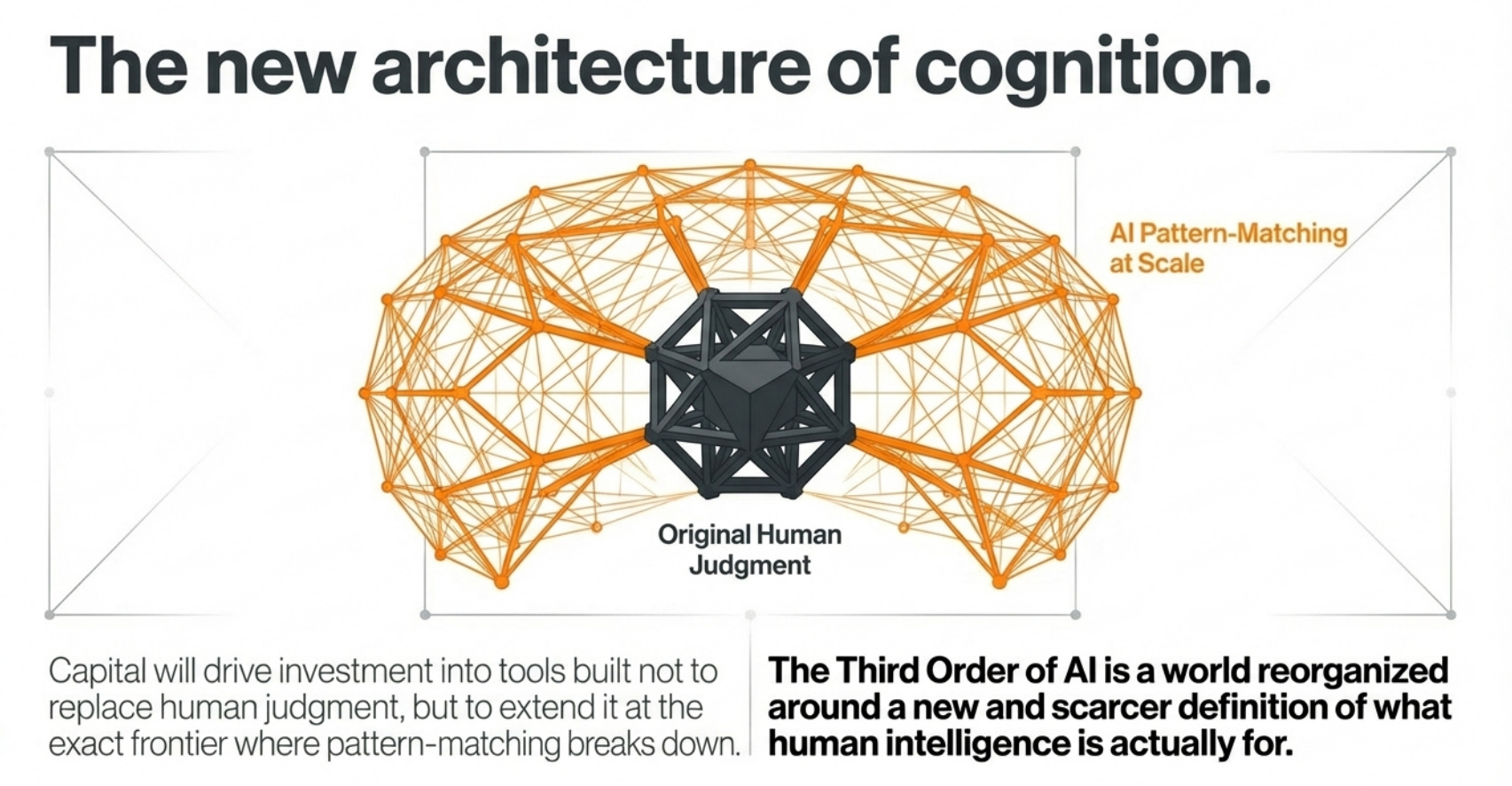
This does not make human intelligence irrelevant. It makes the old definition of it less valuable.
The premium moves away from producing plausible output and toward choosing the right problem, sensing what the model cannot know, spotting when consensus is just recycled language, and taking responsibility for a judgment before the evidence feels complete.
That is a much narrower game. It is also a more demanding one.
The first wave of AI helped people produce more. The next wave will be built around people who can think at the edge of pattern matching.
The point is not human versus machine. That is a shallow argument. The point is which humans become better because the machine exists, and which humans become easier to substitute because the machine reveals that their work was mostly pattern reuse in the first place.
The Second Order of AI was disruption. The Third Order is a sorting mechanism.
It separates information work from judgment work, fluency from originality, output from taste.
The World After the Decision
This is why the Fairchild story matters more than the usual Silicon Valley mythology.
The lesson is not that great people should leave bad bosses. It is not even that one failed lab accidentally produced better companies. That is still company history.
The deeper lesson is that a single defection created a new operating model.
Talent became mobile. Risk capital became believable. Equity became a language between engineers and financiers. Company formation stopped looking like betrayal and started looking like the correct response to constraint.
Shockley thought he had lost eight employees. But, unknowingly he had released a new pattern into the world (VC- backed moonshot ideas).
We mostly watch the first decision. Better analysts follow the second consequence. The rare edge is seeing when the consequences have begun feeding each other, when the original cause has faded, and when the system is quietly becoming the thing that will make the next decision for everyone else.
That is usually how the Third Order announces itself.
It asks you to look past the original decision, past the obvious consequence, and into the system that begins forming after both have faded from view.
Most people would have studied Shockley Semiconductor as a management failure. Better analysts would have studied Fairchild as the second-order consequence. The rare edge was seeing that Fairchild’s children would matter more than Fairchild itself.
Each & every R&D Articles are excellent
Third order thinking evaluautes around the dependency that was created.
I enjoyed this article very much and am reading it again.
1st and 2nd are linear, 3rd is non-linear, and there is the illumination of the recursive system.
Thanks for writing!