
When platforms stop being good
Lifecycle of digital platforms - When Control Replaces Craft
TLDR- Platforms start by serving users. Then they serve advertisers. Then themselves. The product doesn't break. Users stay because leaving is hard. The platform calls that loyalty.
Stripped back, a platform connects two sides of a market: business customers on one side, end users on the other. The interesting part is where the value actually comes from. Not from the platform itself. From the people using it.
In its purest form, the platform is a rules-writer. It contributes very little to the transaction except the permission to transact.
Its real power is not participation. But control.
Digital platforms have a structural advantage most analysis understates. They can adjust everything, constantly, invisibly, and at scale. Prices, feeds, rankings, access, visibility, recommendations. Nothing is fixed by design. Every surface is a variable.
Optimizing for the User
At start, flexibility runs toward the user. The product gets tuned to feel effortless. Discovery improves. Search gets sharper. The experience behaves as if it exists entirely in service of the person using it.
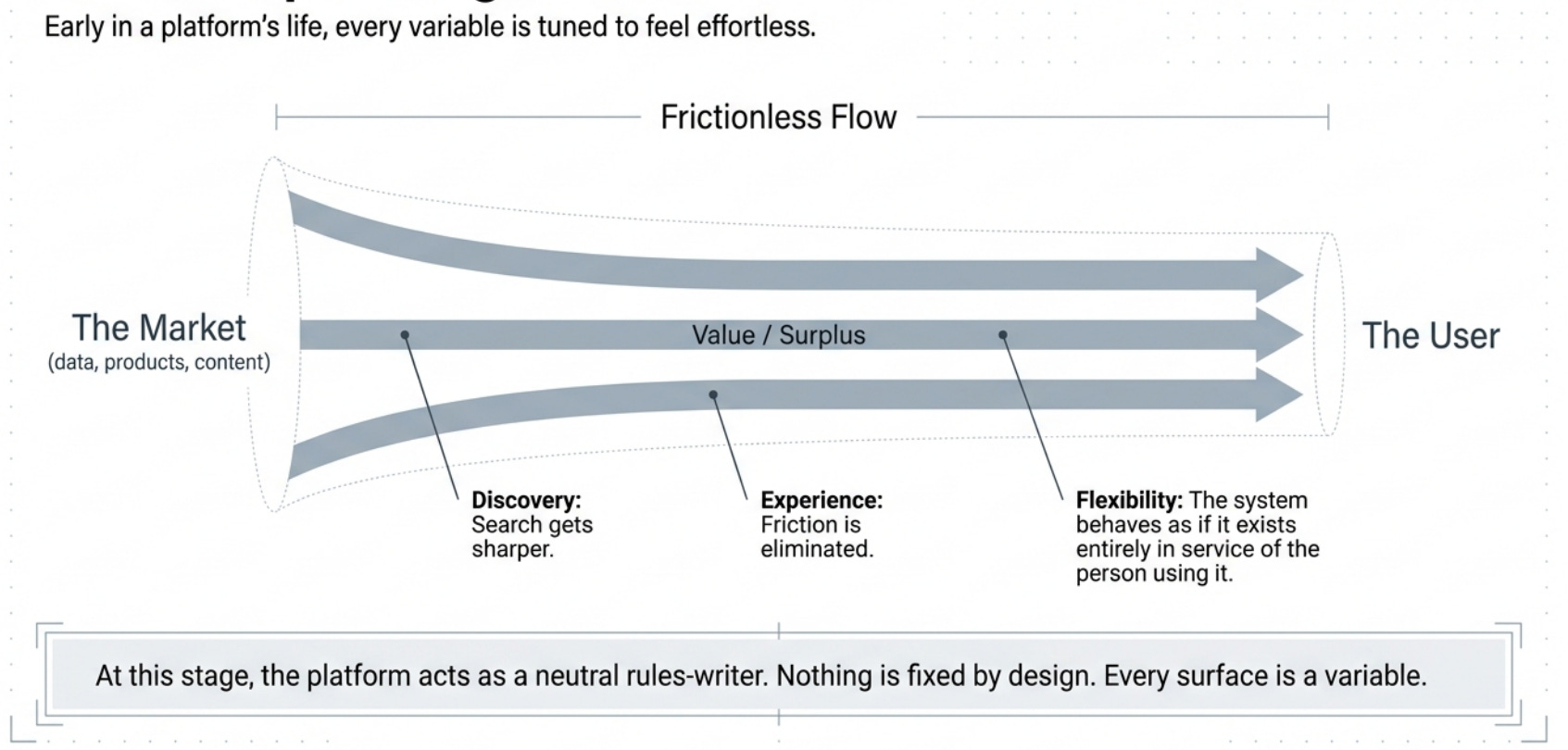
Then the rebalancing begins. Platforms start optimising for monetisation instead.
Feeds become auction surfaces. Attention becomes inventory. Access becomes a pricing decision.
That is what makes the decline feel so strange from the outside. Nothing obvious breaks. The app still opens. But the results get slightly worse.
More ads. Worse search. Lower reach. Higher fees. Darker patterns. Less functionality. More recommendations that are really paid interruptions.
This is what Cory Doctorow calls enshittification
He also calls the internal levers “twiddling”: continuous algorithmic adjustments that shift surplus between users, business customers, and the platform itself.
The important point is not that these levers exist. It is that their direction, over time, is never neutral. They stabilise toward the platform.
Ad tech makes this visible in its cleanest form. A platform that represents buyers, represents sellers, and operates the exchange does not have a conflict of interest. It has a solved problem. The exchange captures more value even as the market it sits on gets worse. Publishers earn less. Advertisers get poorer returns. Users see more low-quality content. The platform becomes more profitable not because it improved the system, but because it controls the rules of it.
The most profitable position is not always to make the thing. It is to own the chokepoint through which the thing must pass.
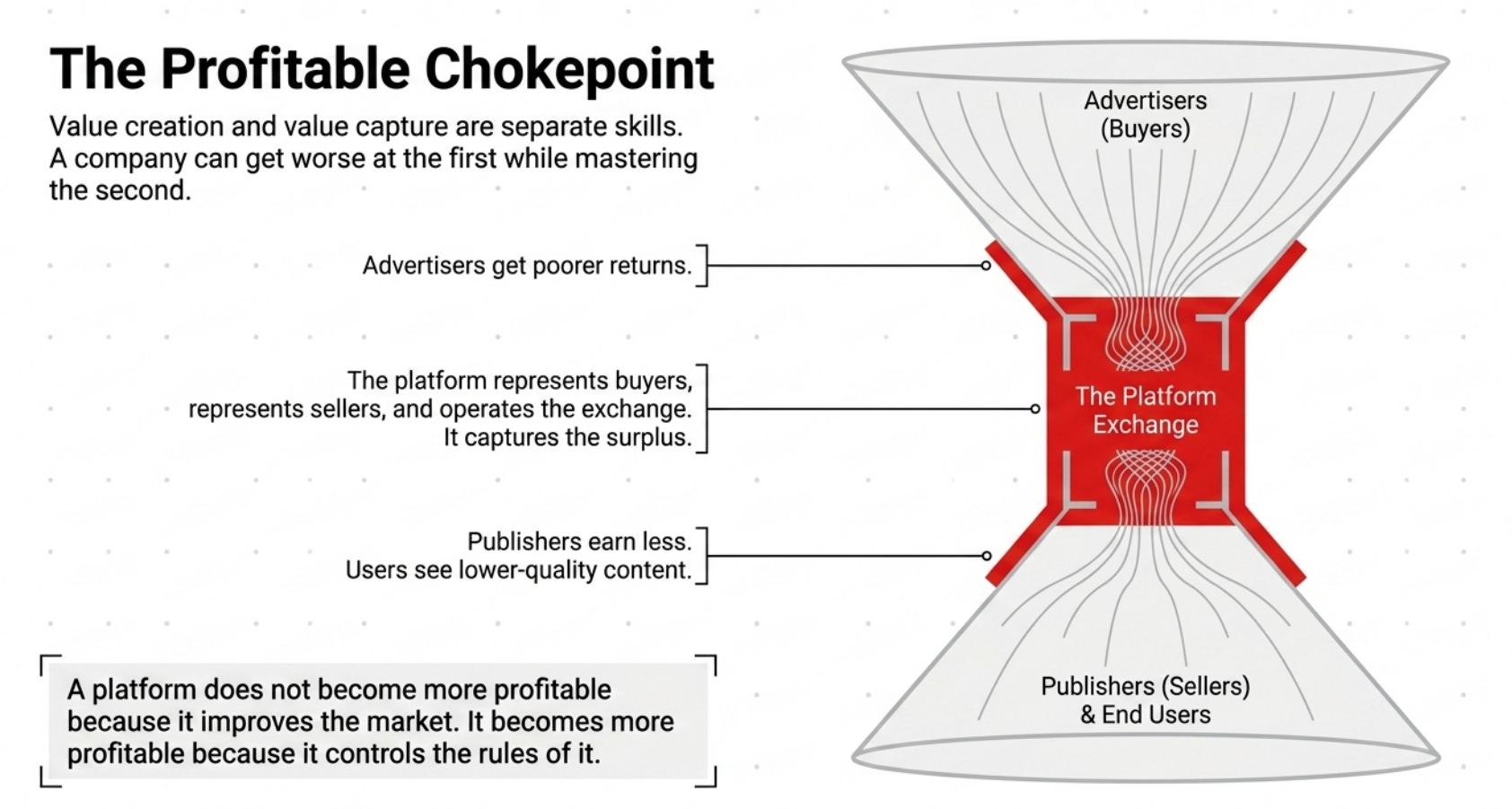
Once you own the chokepoint, value creation and value capture become separate skills. A company can get worse at the first while becoming much better at the second.
What looks like loyalty is often dependency.
This is where companies misread their own metrics. When users complain but do not leave, dashboards register resilience. What the metrics actually show is capture. The switching cost is doing the retention work, not the product.
Once a platform internalises that distinction incorrectly, its decisions follow. It stops asking how to create more value and starts asking how much value can be extracted before something breaks.
The answer is usually: more than you think.
Platforms do not decay because they forget how to build. They decay because they discover they do not have to. Control replaces craft.
By the time the decline becomes visible in outcomes, the incentive structure that caused it has already been locked in for years. This could be one set of example of arguments I started in Inversion Point.
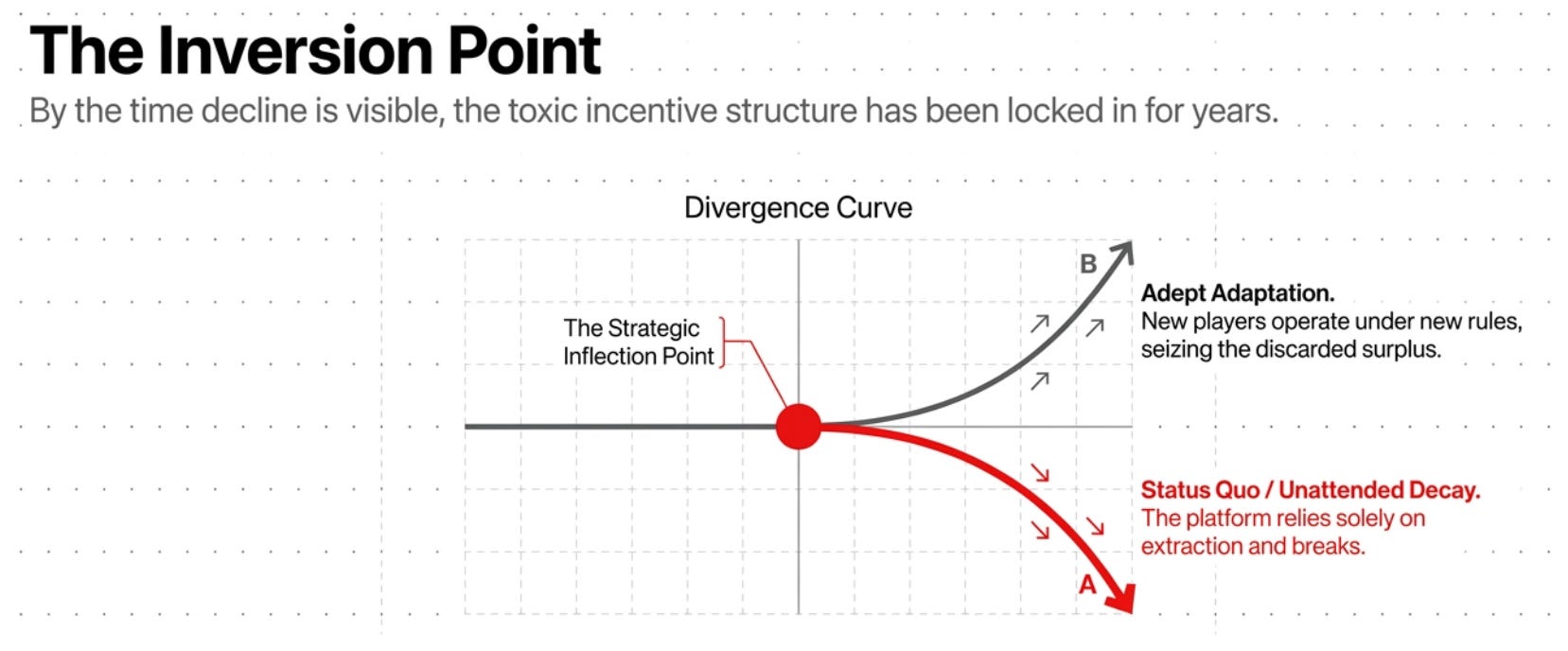
A strategic inflection point can be deadly when unattended to.
But strategic inflection points do not always lead to disaster. When the way business is being conducted changes, it creates opportunities for players who are adept at operating in the new way. - Andy Grove, Only the Paranoid Survive
Your article suggests to me that this phenomenon is related to what Michael Hudson calls the "rentier economy". You charge rent for the use of an asset that you own. Thus, credit card companies charge a per transaction fee. Uber takes a cut from the fare you pay to the driver for using their app. However, the rentier economy model is not the only player in the town. India's National Payments Corporation has successfully created an alternative to the credit card in the form of UPI. A cooperative alternative to Uber - called Bharat Taxi- is already undergoing a prelaunch trials in Delhi and another version is already operating in Goa. So, I believe that the malaise you have correctly identified needs to be put in the context of the economic dogma currently prevailing and alternative systems already being tested.