
Beyond the Moat
When intelligence becomes cheap, what exactly are you defending?
I am in London since last 1 week. Last Saturday, as I was walking down Oxford Street I stopped in front of Selfridges.

The façade still has that old imperial confidence. Monumental columns. Figures carved in stone: Commerce, Progress, the Arts, Industry. Harry Gordon Selfridge did not just build a store. He built a palace of abundance.
That was the promise. Everything valuable, under one roof. Luxury made theatrical. Choice made physical. The moat was the building itself.
Standing there, I kept thinking: what would Selfridge build today?
Because London is still living inside that question. The law firms, consulting firms, and financial towers ( I am staying in canary wharf) were all built around the same assumption: we know things you do not, and thinking costs money.
That assumption is starting to break.
We still speak in the old language. Competitive advantage. Defensibility. Economic Moat.
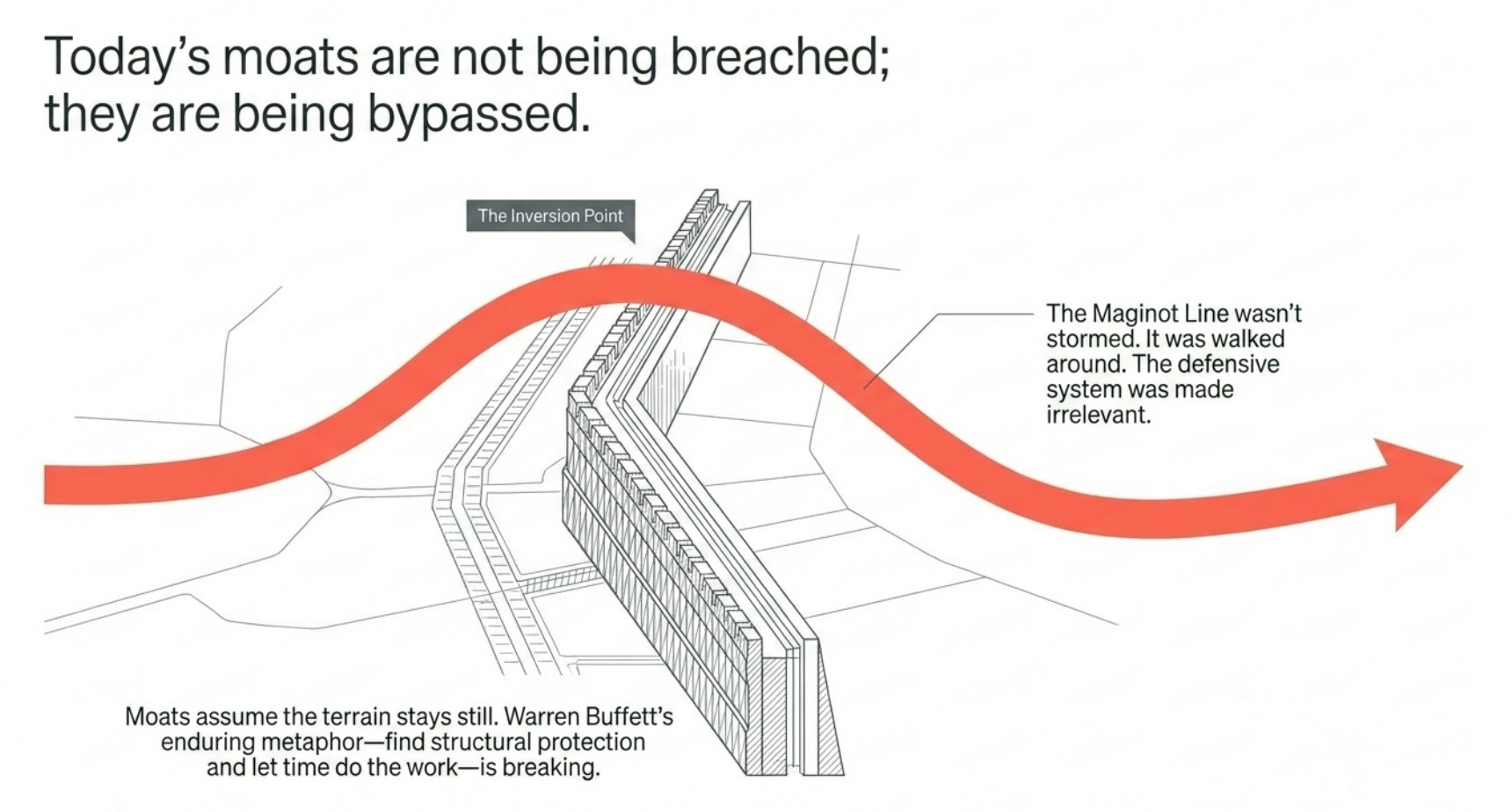
Warren Buffett made the moat the most enduring metaphor in investing: find a business with structural protection, then let time do the work. But moats assume the terrain stays still.
In Inversion Point, I wrote about the Maginot Line, the great defensive system made irrelevant not because it was breached, but because it was bypassed. The Germans did not storm the wall. They went around it.
That is the problem with many of today’s moats.
They are not being attacked. They are being made less important.
The Old Moats
The first moats were physical. Railroads, factories, ports, mines, distribution. You could touch the advantage.
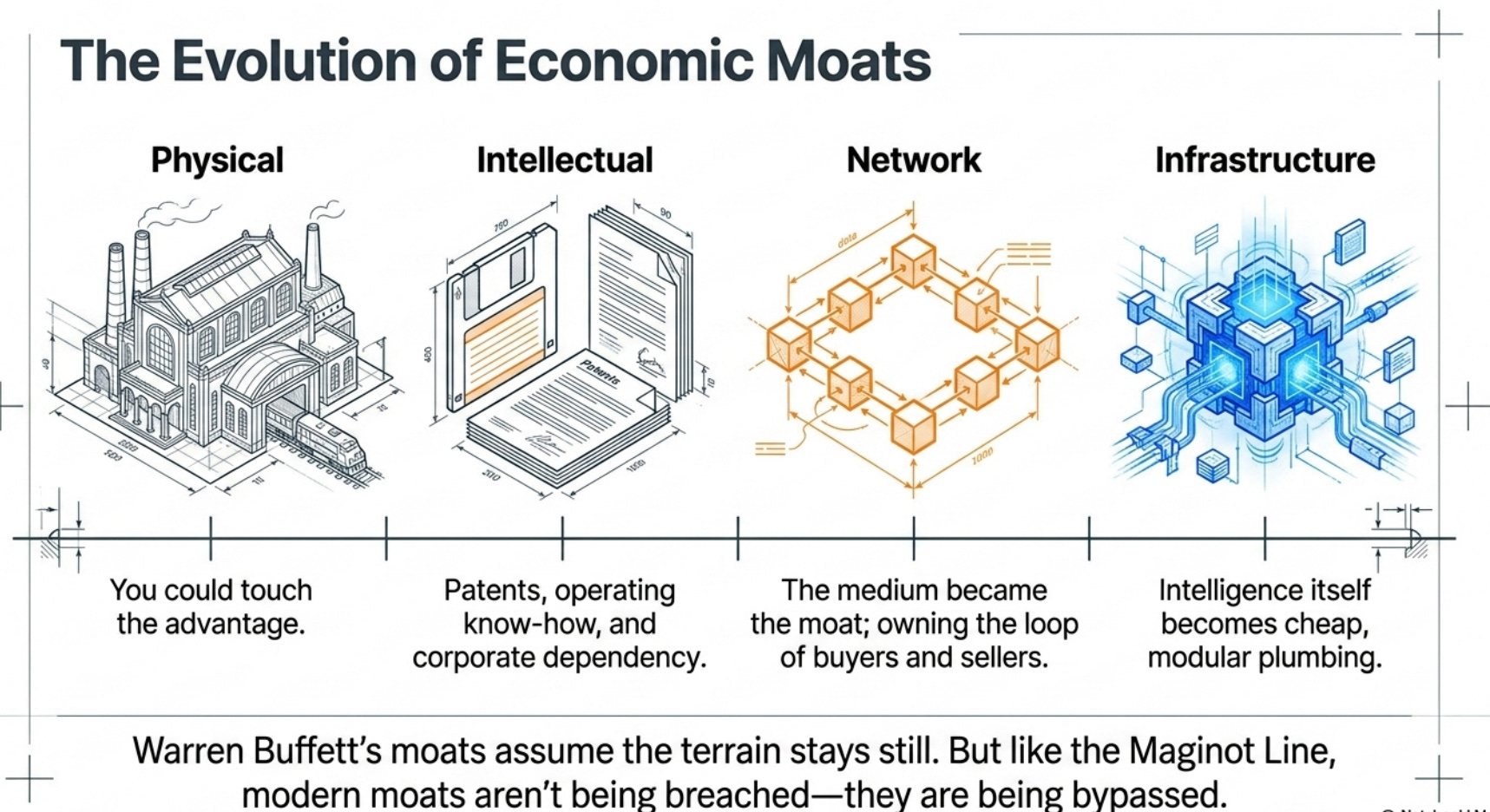
Then moats became intellectual. Patents, brands, operating know-how, enterprise lock-in. Microsoft’s moat was not a server room. It was Windows, Office, developer habits and corporate dependency. Coca-Cola’s moat was not the formula. It was memory, trust and distribution compressed over a century.
Then the internet rewired the game again. The medium became the moat. Amazon did not just own warehouses. It owned the loop: buyers attracted sellers, sellers expanded selection, data improved discovery, discovery attracted more buyers.
Physical capital - intellectual capital - network capital.
For most of economic history, cognitive labor were scarce. Entire industries built their economics around that scarcity.
AI is changing that unit economics of thinking.
And when something becomes cheap, value does not vanish. It moves. This is Abundance Paradox (sorry to repeat it again).
When information became abundant, value moved to interpretation.
When distribution became abundant, value moved to trust.
When creation becomes abundant, value moves to taste.
Now we are entering a fourth phase. Intelligence itself is becoming infrastructure.
The 19th-century economist William Stanley Jevons noticed this pattern in coal. Make steam engines more efficient, and Britain did not use less coal. It used more. Cheaper energy per unit created more demand for energy.
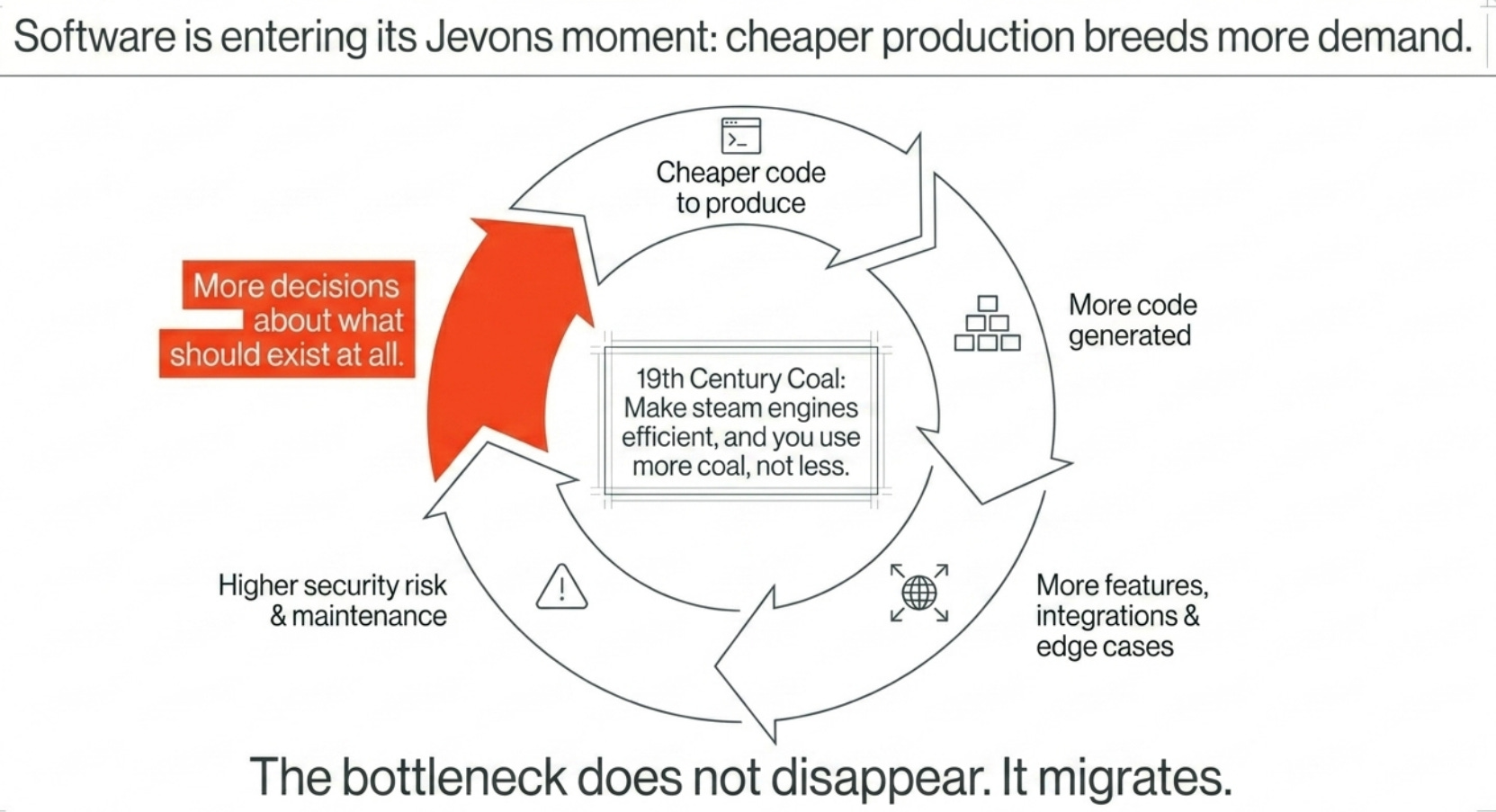
Software is entering its Jevons moment. Make code cheaper to produce and you get more code, more features, more integrations, more edge cases, more security risk, more maintenance, more decisions about what should exist at all.
Where the Constraint Moves
For Indian tech readers, the most obvious version of this is the services-to-software transition.
For two decades, a large part of India’s technology advantage came from trained engineering capacity at scale. The world had work. India had the talent to execute it. That was not a small moat. It built companies, campuses, careers and cities.
But if every developer now has an AI coding layer, the scarce thing is no longer typing code faster.
A services firm can put copilots in every IDE and still not become more strategic. The client does not need more generated code. The client needs someone who understands the workflow, the regulator, the customer, the legacy system nobody wants to touch, the political constraint inside the organization and the decision that should not be automated.
That is the inversion.
The old advantage was execution capacity. The new advantage is problem selection, domain memory and accountable judgment.
The same is true inside Indian startups. AI can produce landing pages, dashboards, pitch drafts, SQL queries, customer emails and product mocks. But it cannot decide which market is worth entering, which customer pain is real, which metric is lying, which feature creates dependency and which one only creates activity.
It can increase output. It cannot choose the right game.
“Competition is for losers.” Peter Thiel, Zero to One
The new moat is more upstream. It is the ability to avoid the wrong competition entirely by seeing where the constraint has moved before everyone else prices it in.
The New Scarcity
If intelligence becomes cheap, what becomes expensive?
Context becomes expensive.
A model can know the internet and still not know your specific customer, your credit market, your underwriting edge, your sales cycle, your cultural moment. Context is local, lived and relational. It accumulates through contact with reality. It cannot simply be scraped.
Curation becomes expensive.
In a world of infinite output, the scarce person is not the one who can generate more. It is the one who can filter, sequence and connect. The editor in a sea of writers. The investor in a sea of data. The operator in a sea of dashboards.
Will becomes expensive.
This is the part most AI debates underprice. AI can execute. It cannot want. It cannot carry conviction. It cannot be accountable to a future it chose.
The direction of intelligence still has to come from somewhere.
If your organization was bottlenecked by document production, AI helps. If it was bottlenecked by judgment, AI exposes you. If it was bottlenecked by courage, AI makes the cowardice more visible.
The CRM Lesson
Consider the CRM.
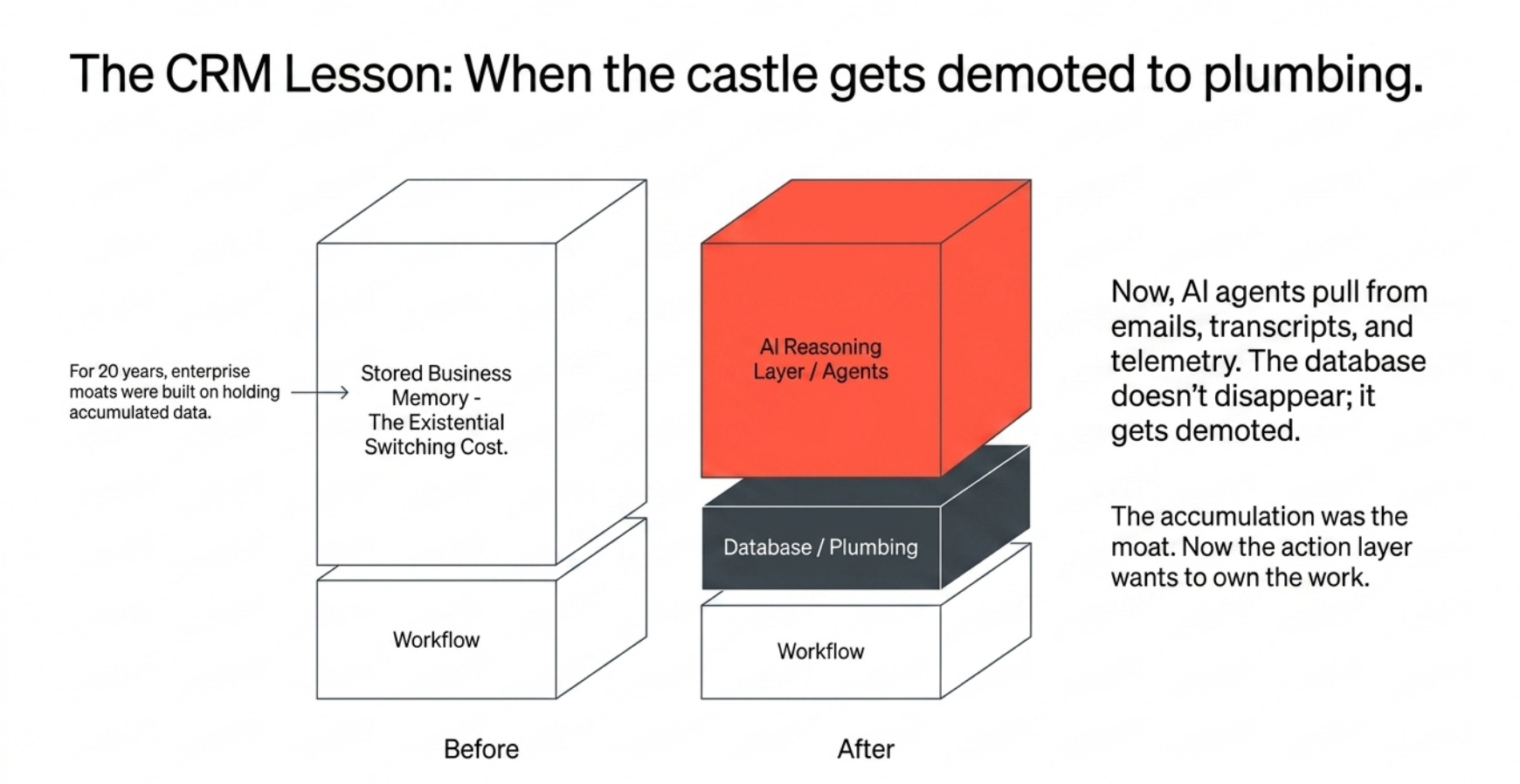
For ~20 years, enterprise software built moats around stored business memory. The switching cost was not contractual. It was existential. Leave the CRM and you leave behind the accumulated memory of your business.
That was a beautiful moat.
Until the reasoning layer arrived above it.
AI agents now sit on top of the CRM, pulling from emails, call transcripts, calendars, support tickets and product telemetry. The database does not disappear. It gets demoted.
From castle to plumbing.
Any incumbent whose moat was built on holding data rather than reasoning over it is vulnerable to the same inversion.
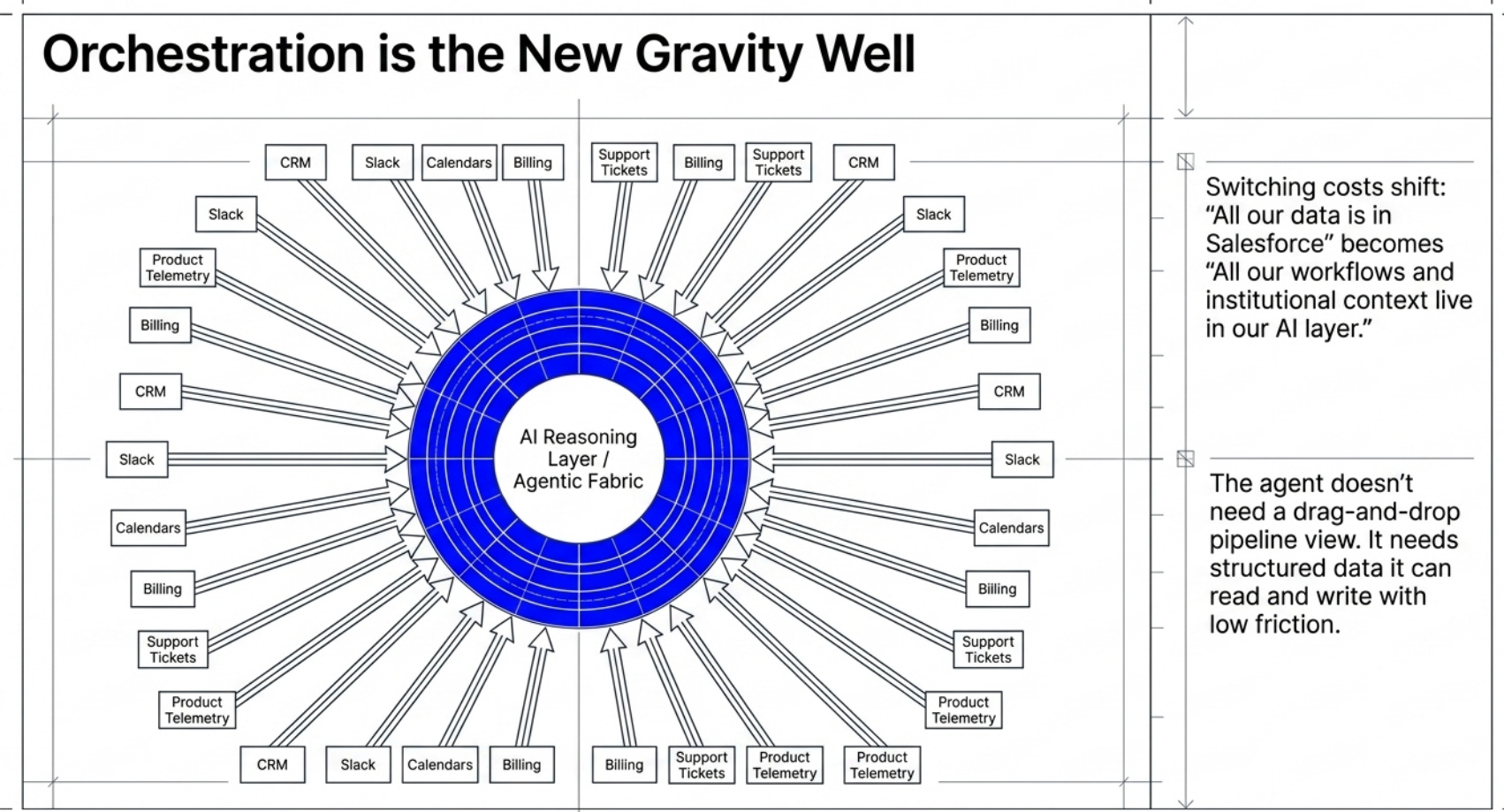
The accumulation was the moat. Now the action layer wants to own the work.
What Survives
The durable moats of the next era will form around three things.
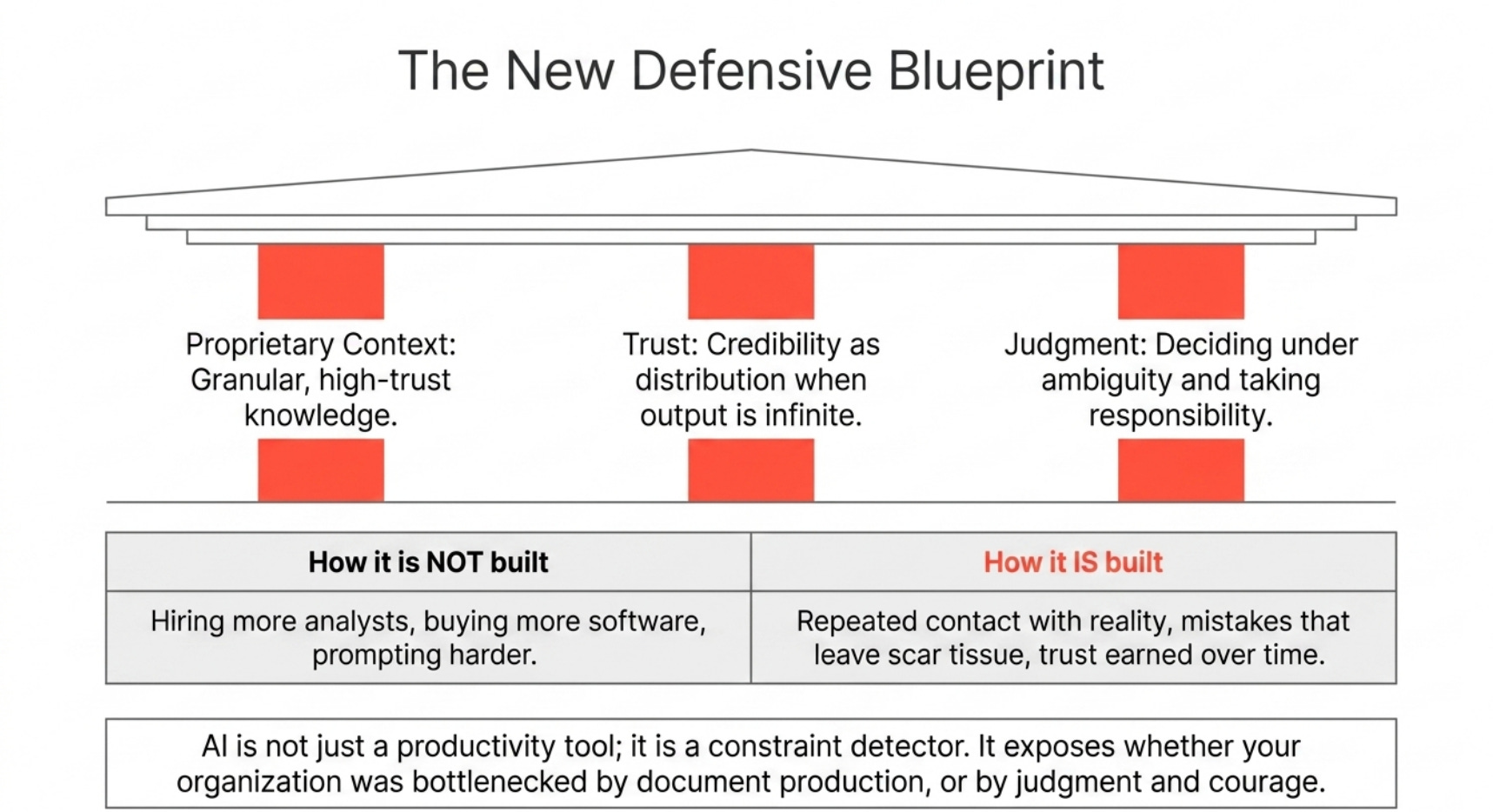
First, Proprietary Context. Not generic data, but lived, granular, high-trust knowledge of a domain. The kind that tells you what the numbers mean before the spreadsheet does.
Second, Trust. When output is infinite, credibility becomes distribution. People return to voices, products and institutions that help them see clearly.
Third, Judgment. Ability to decide under ambiguity, hold a line, take responsibility and choose what the machine should optimize for.
This is why the old question, “What do you know that others do not?” is becoming less interesting.
The sharper question now is: “What do you understand well enough to act on?”
That is a harder moat to copy. It is not built by hiring more analysts, buying more software or prompting harder. It is built through repeated contact with reality, through mistakes that leave scar tissue, through trust earned over time.
I walked back past Selfridges later that evening. The columns were still magnificent. Commerce. Progress. Arts. Industry. Still watching.
But the roof is no longer the moat. Everything is already everywhere.
So whether the thing you are defending is still where value is being created.
Most excellent, thank you for opening the shade on the ew window of vision.
Brilliantly explained.