
Hosting the Machine
India solved the execution layer once. AI is testing whether it can own the loop.
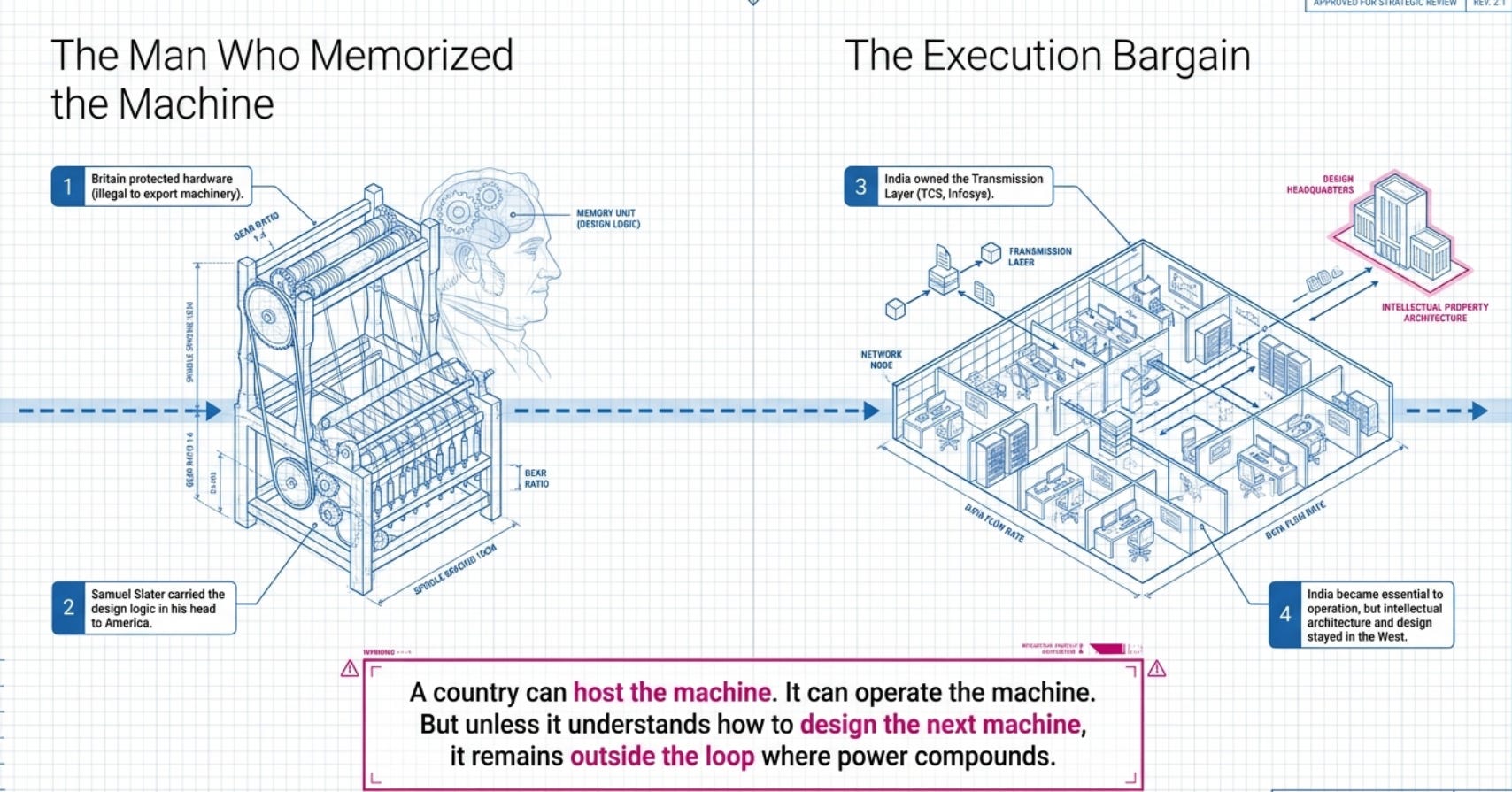
In 1786, Britain tried to protect its textile advantage by law.
The country had built the most productive cotton mills in the world, and it understood. The machines were not just machines. They were the industrial edge. So Britain made it illegal to export textile machinery, mechanical drawings, or the knowledge required to reproduce them elsewhere.
Samuel Slater found the gap.
He had spent years inside Richard Arkwright's mills, not merely operating the machines but studying them closely enough to understand how they worked. The ratios, tolerances, frame geometry, and small design choices that turned cotton into consistent thread at scale.
When Slater left for America in 1789, he carried no drawings. He carried the machine in his head.
Within two years, he had rebuilt the spinning frame in Pawtucket, Rhode Island. Britain had protected the hardware. It had not protected the person who understood the design logic deeply enough to reconstruct it.
A country can host the machine. It can operate the machine. It can even become indispensable to its daily running. But unless it understands how to design the next machine, it remains outside the loop where power compounds.
Britain learned this the hard way. So did India in a different era, with a different machine.
Execution bargain
In the early 1990s, a structural window opened for India.
For two decades, India owned the transmission layer between Western enterprise demand and global software execution. The work was not glamorous, but it was real. The rents were real so was the capabilities.
But the bargain had a ceiling: India had the execution. Someone else had the agency.
The product decisions, pricing power, roadmap, intellectual architecture, and next-generation capability stayed elsewhere. India became essential to the operation of global technology without becoming central to its design.
Taiwan built TSMC. Korea built Samsung. India built outsourcing.
That was not failure. It was one of the most successful labor-arbitrage engines in modern economic history. But it did not produce the next chokepoint. India became indispensable at running systems designed elsewhere, and then mistook indispensability for control.
The constraint in that era was access to work. India solved for it brilliantly.
The constraint now is different.
Infrastructure Bet
India is now becoming a host for AI infrastructure.
The land, the power, the data centre partners, the users all Indian. Inference demand will increasingly come from Indian languages, consumers, enterprises, institutions.
But the silicon is designed elsewhere. GPUs fabricated elsewhere. Frontier models trained elsewhere. Weights, pricing logic, roadmap all elsewhere.
India's contribution is becoming the foundation.
That foundation is not cosmetic. India needs data centre capacity for AI to reach its population at scale. Compute needs geography. Latency matters. Energy contracts matter. Deployment capacity matters. No serious AI economy exists without infrastructure.
The mistake is not building the infrastructure. The mistake is treating it as the strategy.
Every Indian-language inference running on a foreign model from a server in India is a contradiction: locally hosted, externally owned; nationally consumed, not nationally governed. It sits on Indian land, uses Indian power, serves Indian users but the learning loop points outward.
That is the old bargain, updated for a more dangerous layer.
In the software services era, India operated systems designed elsewhere. In the AI era, India risks hosting intelligence designed elsewhere.
This is Inversion Point. Same advantages that made India an execution hub scale, technical labor, deployment capacity, tolerance for complexity now make it a natural infrastructure host. But if the design layer remains external, the advantage quietly becomes the trap.
The host gets utilization. The owner gets the loop.
The Loop
A tenant captures usage. A producer captures improvement.
That is the distinction India should care about not because of nationalism, but because of compounding.
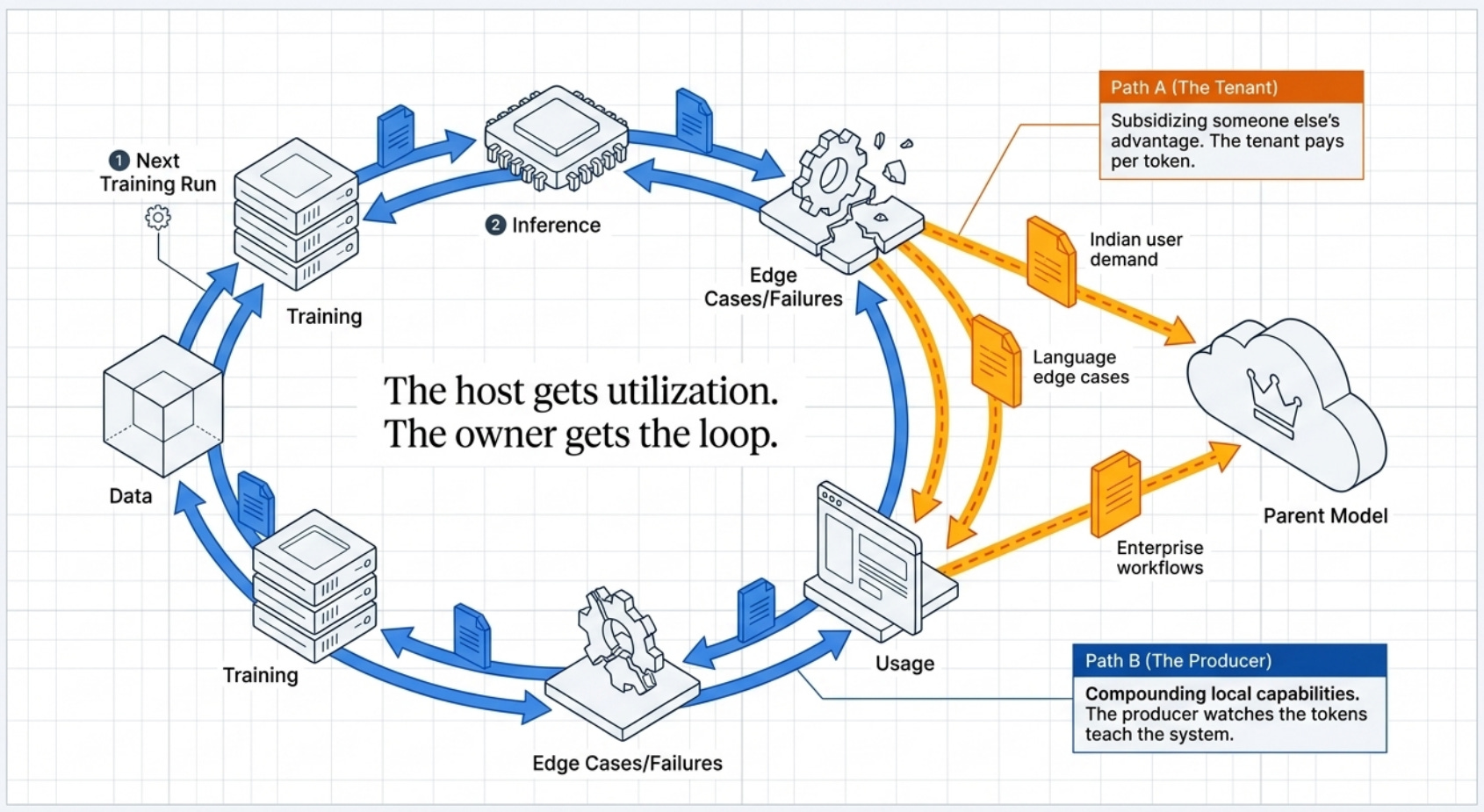
In AI, the loop runs: data → training → inference → usage → feedback → next training run. The model improves as the system sees more queries, edge cases, languages, failures, corrections, workflows, demand patterns.
Whoever sits inside that loop decides what improves, what gets priced, which capabilities become default, which languages are supported deeply, which constraints are pushed onto everyone else.
India has one of the largest AI demand pools in the world. Language diversity that cannot be scraped from the public web. Fragmented institutional workflows that should produce defensible context. Population-scale usage that should, in theory, become a training advantage.
But only if that usage flows back into capability India owns.
If Indian users generate demand, Indian enterprises generate workflows, Indian languages generate edge cases, and Indian infrastructure carries inference but the learning loop improves a foreign model then India is not building an AI advantage. It is subsidizing someone else’s.
This is the tenant arrangement:
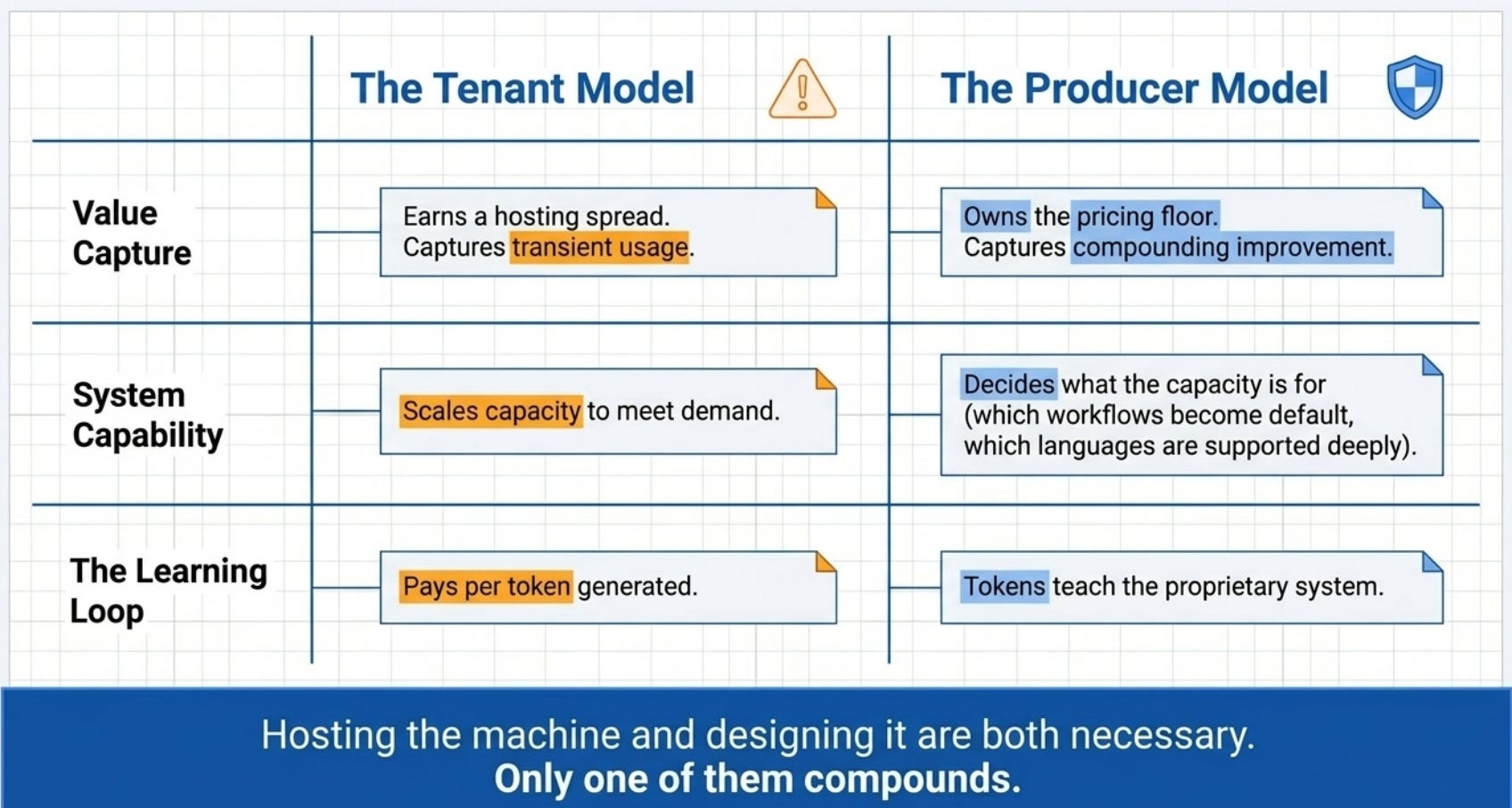
The tenant pays per token. The producer watches the tokens teach the system.
The tenant earns a hosting spread. The producer owns the pricing floor.
The tenant scales capacity. The producer decides what capacity is for.
While both hosting the machine and designing it are necessary. But, only one of them will compounds.
This does not mean India must train a frontier model tomorrow. The question is not whether India can immediately beat the best labs at their own game.
Question is whether India is building toward ownership of any meaningful loop.
Sarvam matters here because it is one of the few Indian attempts to move from deployment into model ownership. Its work on Indian-language models, and the release of open models such as Sarvam 30B and Sarvam 105B, is directionally the right answer to the tenant problem. It is the Slater move: learn the machine deeply enough to rebuild part of it locally.
But Sarvam also proves the scale of the gap. A domestic model is not the same thing as domestic control over the full loop. The question is whether India can produce many such attempts, connect them to proprietary Indian usage, enterprise workflows, public datasets, distribution, compute, and feedback, and turn that into a compounding capability. One credible model lab is a beginning. It is not yet an architecture.
If India builds only the buildings, signs only the power contracts, imports the chips, hosts the inference, and celebrates deployment it solves the visible part while leaving the compounding part untouched.
The Trap
The deeper danger is not that India cannot win at the frontier. It is that the public conversation turns that constraint into a comfortable excuse.
Because the frontier feels unreachable, the argument goes that it doesn’t matter. Because deployment is achievable, it becomes the destination. Because data centers are fundable, they become proof of strategic seriousness.
Some of this is honest. You cannot pretend capability into existence. Frontier models are brutally expensive and talent-dense. There is no virtue in slogan-driven policy.
But honesty can become an excuse.
The 1990s version was: we are not ready to design systems, but we are world-class at running them. That was true. It also became the logic that kept the next layer unbuilt for thirty years.
The 2026 version sounds similar: we are not ready to train frontier models, but we are world-class at deploying them. This may be true. India will deploy AI at enormous scale. It will host data centers, create demand, localize applications, wrap foreign intelligence in Indian distribution. Some of that will be valuable.
But none of it answers the structural question.
Is India inside the loop that produces intelligence, or outside it?
The buildings will be India’s. The power, the demand, the users all India’s. But intelligence may not be.
That is the Inversion Point I have written about before: when yesterday’s advantage quietly becomes tomorrow’s cage. India’s strength scale, technical labor, deployment capacity now makes it a natural host. But if the design layer stays external, the host becomes a tenant. Indispensable, but not in control.
And the second order of that arrangement is brutal. The tenant pays per token. The producer watches the tokens teach the system. The tenant scales capacity. The producer decides what capacity is for. The tenant captures usage. The producer captures improvement.
Before the concrete sets, ask: is India building AI capacity, or leasing access to someone else’s compounding machine?
The answer will decide the next few decades for us.
saying 'LANDLORD MODEL' may make it clearer than calling it TENANT MODEL.
Not a fan of Indian National Congress, yet the leader of opposition happened to argue the very same logic you laid out — if without as much nuance — in the Feb budget session –
https://youtube.com/shorts/9pn-6usLGdM