
Why is this worth knowing?
After Girl Number Twenty, the harder question is not only what is worth knowing. It is why anything deserves our attention at all.
This post will not answer the question fully.
I must admit that at the start.
The last essay, Girl Number Twenty, was about schooling, facts, and judgment. But the better part of the essay happened after the essay. Sumant pushed the argument toward something older and harder: every civilization ranks knowledge. Some knowledge becomes sacred. Some becomes practical. Some becomes dangerous. Some gets dismissed until history forces us to look again.
Then he added the sharper question. “What is worth knowing?” is incomplete without “why?”
That “why” is where the ground starts moving.
So this post is not a conclusion, rather more like the next room in the same house. I am trying to think this through with readers who are better informed than me in many directions. Now, theGreySwan works best when the post is not the final word, but just a first move in a better conversation (more on this in the last section).
Quiet prediction
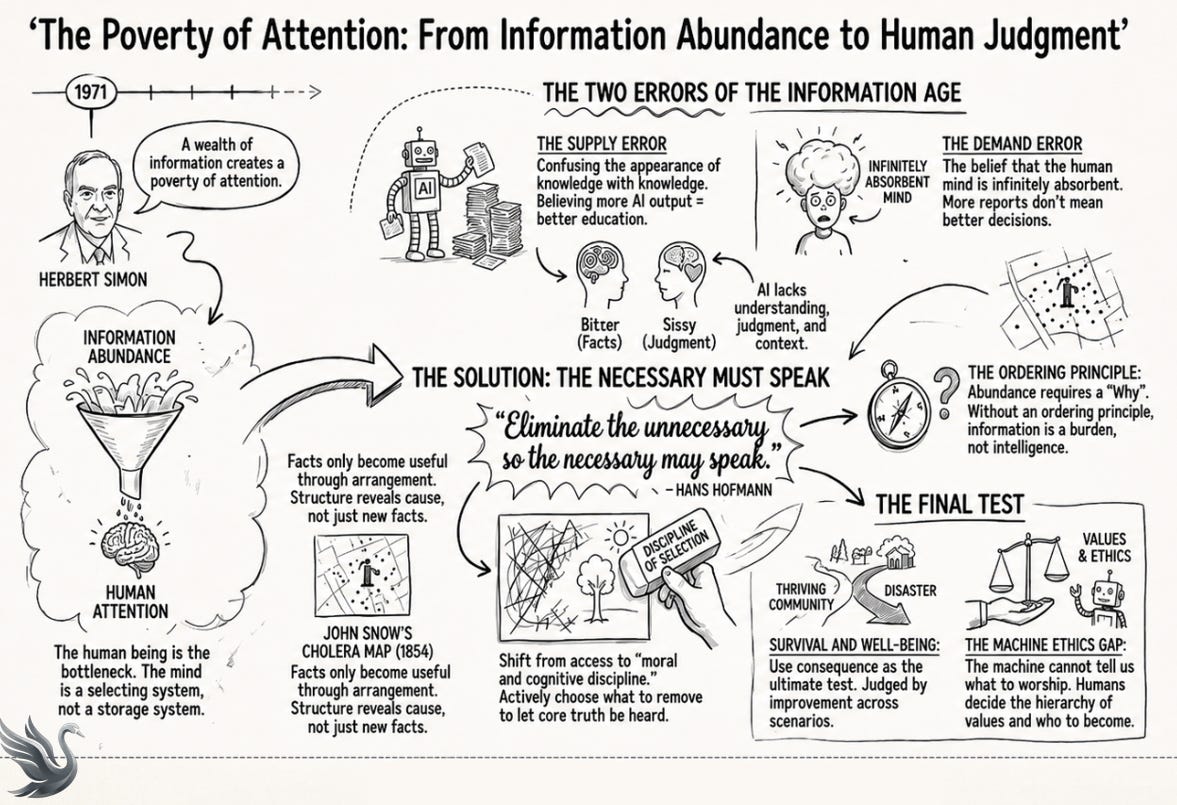
In 1971, Herbert Simon (Nobel Prize winner) was looking at a world that still treated information as expensive.
“Information consumers the attention of its recipients”- Herbert Simon, 1971.
A large computer filled a room. Reports arrived on paper. Data had weight. Knowledge still looked like something produced by institutions, filed in cabinets, printed in journals, and carried by experts. The problem of that age seemed obvious: how do we produce more information, faster?
Simon saw the opposite problem forming.
“Machine will be capable, within twenty years, of doing any work a man can do.” - Herbert Simon, 1965.
But, then in 1965, he had made the prediction everyone remembers, and that claim failed in the visible way. The humanoid robot did not walk into the office and take over the desk. For decades, the machine remained clumsy where human hands, judgment, and context were required.
But Simon’s quieter 1971 line aged better:
A wealth of information creates a poverty of attention.
That was not a comment on distraction, rather a constraint map.
If information becomes abundant, attention becomes the scarce input. (I know this get repeated many time at TGS).
But, then if producing becomes cheap, receiving becomes expensive. If every institution, platform, school, company, and machine can generate more signal, the bottleneck moves to the human being expected to absorb it.
Simon was not warning us that we would waste time. He was warning us that the receiver had limits.
We built the modern knowledge system as if the receiver did not.
Supply error
Girl Number Twenty was about the supply error.
Dickens gave us Gradgrind’s schoolroom in 1854: plain, bare, monotonous, built around one kind of approved answer. Bitzer knows the facts. Sissy carries the understanding. The system rewards the first and fails to even see the second.
Cost of producing Bitzer’s answer has now collapsed. A student can produce it. A consultant can produce it. A founder can produce it. A model can produce it in ten styles, in five examples, and a tasteful closing paragraph.
This does not solve the old schoolroom problem, rather further scales it.
So, the supply error is the belief that better education means more correct information.
More facts. More notes. More summaries. More answers. More content. More output.
But facts were never the same as judgment. A correct answer can still be a weak act of thinking. A well-structured explanation can still avoid the problem. A polished paragraph can hide the absence of encounter.
This is the first discomfort AI exposes. We had already confused the appearance of knowledge with knowledge. The machine simply made the confusion cheaper.
Demand error
Now, there is another error on the other side.
In 1839, William Farr (one of the founders of medical statistics, more on this in my old post - Silent Revolution) joined the General Registry Office in London and began turning death records into vital statistics. The point was not just to count the dead. Counting alone produces a heap. Farr understood that facts become useful only when arranged in a relation that lets the mind see something it could not see before.
John Snow’s cholera map in 1854 did the same work.
The Board of Health had data. London had smells, deaths, streets, wells, complaints, doctors, theories, and panic. The city was not short of information. It was drowning in the wrong arrangement of it. The dominant theory of disease, miasma, made the visible smell feel like the cause. Snow’s map did not add some magical new fact. It changed the structure through which facts were seen.
That is the demand error: belief that the human receiver is infinitely absorbent.
We, keep adding material thinking that the mind will keep processing. So, we keep sending updates thinking that the manager will become better informed. We, keep generating reports thinking that the board will make better decisions. We, keep giving children content thinking that this will become them educated.
But the mind is not a storage system. It is a selecting system.
And, the selection requires a reason, which means some form of judegements.
This is where Sumant ji’s question becomes uncomfortable. “What is worth knowing?” cannot be answered by information supply. It requires value. It requires an ordering principle. It requires someone to say: this matters more than that, and here is why.
Without the “why”, abundance does not become intelligence. It becomes burden.
Necessary Must Speak
Hans Hofmann (a German-born American painter, renowned as both an artist and teacher) spent decades teaching painters. His world seems far away from AI, education, and attention, but his instruction may be the cleanest one for this moment:
Eliminate the unnecessary so the necessary may speak.
He was not defending minimalism as taste. He was describing a condition of perception. A crowded canvas does not become richer because it contains more. At some point, the eye cannot find the relationship. The necessary is still present, but it has been silenced by everything around it.
This is now true in every knowledge domain.
The problem is no longer access to information. The problem is the moral and cognitive discipline of deletion.
What do we remove from the classroom?
What do we remove from the dashboard?
What do we remove from the prompt?
What do we remove from the strategy deck?
What do we remove from the child’s day?
What do we remove from my own reading?
Deletion sounds like loss only in a scarcity world. I talked about this at length in Maximum Constraint.
In an abundance world, deletion is how meaning survives.
That does not mean ignorance is wisdom. It does not mean old knowledge is always better than new knowledge. It does not mean meditation replaces measurement, or measurement replaces meaning.
These are lazy exits from the harder question, since the core question is this: what kind of human being is being formed by the knowledge we choose to preserve, reward, and repeat?
A civilization reveals itself through that choice.
The medieval church ranked knowledge one way. Renaissance science challenged that order. Indian philosophical traditions ranked inner perception, logic, liberation, ritual, and material knowledge in different ways. Modern schooling ranked measurable recall and employable skill very highly. As Prof. RANGAMANNAR S VEERAVALLI said to be during our Google-Meet call, that Core of Indian educations was to build character, not knowledge.
Today, internet has ranked searchable information, Social platforms has ranked engagement, and AI is now ranking producible answers.
So before we ask what is worth knowing, we have to first ask what kind of person is worth becoming.
A better conversation
Girl Number Twenty asked what happens when education mistakes facts for judgment. This post asks what happens when abundance forces us to rank knowledge again.
The next question is harder still: who gets to decide the ranking, and by what test?
For now, I only have a working answer.
Keep what improves judgment. Remove what only imitates knowledge.
Steven Johnson has written about coffee houses as “liquid networks”, places where ideas could collide without being trapped inside a single institution. The old coffee houses were called penny universities because the price of entry bought access to conversation, not certification.
Now, this is the small (new) ambition I have for TheGreySwan.
If you want to continue it beyond the comments, I am on X and LinkedIn.
One more thought experiment, while I did created the infographics (from NotebookLLM, as awalys- a 15 slides deck), but this time I decided to NOT put it here, so that flow of the texts are not disturbed. If you wish for the deck, pls head here.
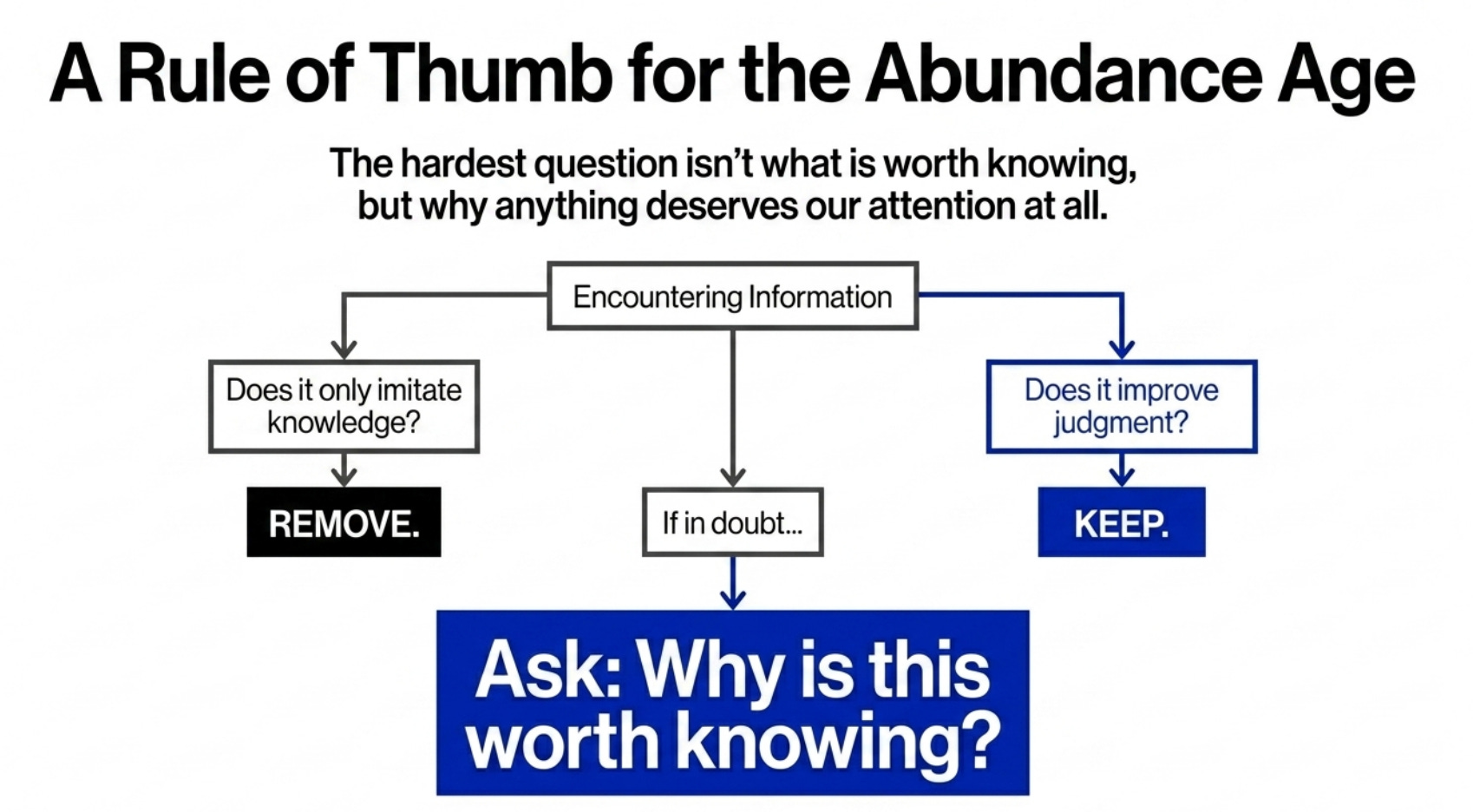
Also, remember when in doubt, ask the question Sumant forced back into the room: why is this worth knowing?
Reminded me of this comic: https://poorlydrawnlines.com/comic/knowledge/
Also the quote — "THE ILLITERATE OF THE 21ST CENTURY WILL NOT BE THOSE WHO CANNOT READ AND WRITE, BUT THOSE WHO CANNOT LEARN, UNLEARN, AND RELEARN. "
~ALVIN TOFFLER
Just followed you on LinkedIn ✌️
It's an interesting read. The question has always been about "Why". The what and how generally follows.